Sunday, October 15, 2006

View from the Googleplex

Google's CEO had words of reassurance for "content companies" during this recent interview with the Financial Times, but they were tempered with a warning for the slow and reluctant.

Here's Eric Schmidt sounding like a cooperative and cozy partner:

All of the media companies are dealing with dramatic changes in their business. All of them are looking for a partner. All of them are looking for a way to make money. One of the great news, from our perspective, is people are using this content on the internet. The bad news is it doesn’t make as much money for the businesses. And ultimately the businesses need to make money in order to produce the new content. So what we’re trying to do with all of these partners is to say, ‘if you work with us we can combine our advertising platform and your content with a much larger audience.’ So far people like that message, they are now trying to figure out what to do about it – should they, should they not, under what terms, and those sort of things.


And then here's a taste of the warning he had about the kind of change ahead, and about winners and losers:

You know, every technology dislocation has winners and losers. And the winners are the companies that can adopt these technologies more quickly and the losers are the ones that are stuck, unable to make the transition, unable to take advantage of new technologies. It is clear that the internet and the web and what is generally known as a marketing term of web 2.0 are the defining new technologies. I think that race is underfoot. It’s too early to say who the losers will be. Clearly the winners will include companies like Google and all the other companies that have made their bets on web 2.0.

I think partnerships will be key, and I think we need to get started. Some may turn out to be fundamental building blocks of the 21st century news company. Others will be useful for a while and then fade as conditions change, or as our own capacities grow. Still others will, of course, turn out to be mistakes.

Ready, fire, aim.

We're engaged in that at corporate; I hope many of you are doing the same thing at home.
–Howard Weaver

Saturday, October 14, 2006

Visit scenic atomictown

Chances are that few of you will ever visit Kennewick, Pasco or Richland, the three communities that make up Tri-Cities, WA. But all of you should visit atomictown.com, the entertainment website of the Tri-City Herald.

The entire online operation at the Herald is a continuing workshop in oportunistic innovation. When they get an idea at the Herald, they just do it. The site was a leader in getting high school football video online, runs a killer interactive garage sale workshop, and generally takes full advantage of available, open source tools to make things happen. The small staff there maintains a robust main website, special sites for Kennewick Man and the Hanford nuclear facility, news in Spanish and much more.

My current favorite is atomictown.com, and especially the way staff writer Bethany Lee translates her work into high-quality video. For example, take a look at Bethzilla, Music for Firday the 13th.

How do they do it? Andy Perdue knows: APerdue (at) tri-cityherald.com
–Howard Weaver

Friday, October 13, 2006

Reinvention at the LA Times

You'll no doubt see the NYT story describing how the Los Angeles Times has assigned editors and investigative reporters to examine ways to reinvigorate their work and find new connections with readers. I recommend it.

Among my favorite nuggets:

'We shouldn’t be waiting for corporate headquarters or a think tank or a consultant to come up with ideas to secure our future,' said Marc Duvoisin, an assistant managing editor who will direct the investigation ...

'We realized we had to act fast or we wouldn’t have anything to act for,' said Vernon Loeb, the paper’s California investigations editor, who helped originate the idea.

–Howard Weaver

Monday, October 09, 2006

Young people and news

Here's a short but illuminating report about an Online News Assocation panel of young people talking about how and where they get news. There's nothing new here, but it's crisp and definitive:

If you want to feel old, ask some young people about how they consume news. An ONA Saturday morning panel featured four “digital natives” ranging from 12 to 20 years old who’ve grown up always living in a technological world. Dale Steinke reports below…

Think RSS feeds, off-beat news links shared among friends via IM, social-networking sites, e-mail alerts and short-form stories. No TV in real-time.
It also makes the point that young people don't seem interested in government and political news. Duh. This is the one finding that doesn't scare me; neither was I when I was 12-20 years old ...
–Howard Weaver

Sunday, October 08, 2006


Tower tumbles


When I want to tell people where I live in Sacramento, I use the Tower Theater as a landmark. It’s an old art deco art cinema and restaurant built at the site of the 1940s drugstore that sold 45-rmp records and launched the business that became Tower Records.

Tower was a treasured Sacramento institution, a local business that went global, made money, got cool. As recently as my arrival 11 years ago, its West Sacramento headquarters was an important hub in the worldwide pop music pantheon, a place where aging hippies with pony tails would cut off the neckties of visitors who didn’t know the company dress code.

And now, Tower is no more.

Owners made a lot of excuses for the declining business over the years. My favorite was the contention that there just wasn’t as much good music to sell nowadays. Much of the analysis now talks about how the company was killed by the internet.

But that’s not quite right, of course. What killed Tower was its inability or unwillingness to adapt to the internet.

The Sac Bee has the story here, including this observation:

"If you look at Tower Records over the last 30 years, this is a company that never really changed," said George Whalin, a national retail consultant who grew up near the Tower store on Broadway in Sacramento. "Look at Russ' history -- he's a store guy."
– Howard Weaver
Who do you have to decapitate
to get on Page 1 around here?

Don't miss Michael Kinsley's take on the Tribune Company's situation, op-ed in the Los Angeles Times. Smart ... and fun.
News crush


Barb and I have a weekend house nestled amongst vineyards in
California's Shenendoah Valley, about 60 miles east of Sacramento. I no longer drink, but Barb tells me the neighbors make fabulous wine from the Zinfandel and Syrah grapes they grow nearby.

Right now, they're involved in "the crush," a frantic time of year when the grapes have reached optimum ripeness and the vintners are working around the clock to turn them into wine. A year's work and millions of dollars will hang on how the magic of chemistry and taste evolves over the next few weeks.

Our neighbor Elisheva describes the crush simply as "war," and we have all learned not to interfere or expect any significant interaction until it's over. For instance, we really need to have a road committee meeting to get started with some repairs before the rainy season – but there is no point at all in raising those issues now.

What's that have to do with the news business? Well, it seems like an apt analogy for the management challenge you're all facing. Welcome to the news crush; clearly, this is war.

You’re all in the midst of building budgets you know will be hard to live with. You’re dealing with publishers and ad directors focused intently on revenue growth and with circulation departments nervously watching the losses mount. They all want you to satisfy yesterday’s readers in tomorrow’s paper.

And you must, of course, or we won’t make it. But you also have to change how we deal with audiences going forward:

  • Your front page needs to be more compelling, starting tomorrow. You have to encourage new voices, tune the coverage to include new reader preferences, compete more effectively with alternative sources of information and new distractions.
  • You have to move swiftly to fill the new channels we know audiences are moving into: 24/7 updates and alerts; video; cell phones and other mobile platforms.
  • You have to give up the idea that we can serve as ultimate gatekeepers, while not abandoning the sense of standards and professionalism that make us unique and valuable.

Last week an unexpected rain fell on many of the vineyards here. Wet grapes, left unpicked, quickly develop mildew, so other plans went out the window and important tasks were left undone while crews were mobilized to harvest. They might not be able to save all the grapes, so they started with the most valuable. They prioritized quickly and worked furiously.

I watched all this from the sidelines, of course, my only contribution being to stay out of their way.

And our neighbors – smart, politically active people and avid news consumers – are on the sidelines for our fight. We have to figure it out for ourselves.
–Howard Weaver

Tuesday, September 26, 2006

vita.mn therapy

I've flagged the Minneapolis entertainment website vita.mn for you before. As you know, it's now in a soft launch phase, and there are still some features (like good RSS feeds) to attach, but the reviews have already started to come in.

Believe me, you're gonna want this for your own sites. It's worth you while to pay attention now.

Ken Doctor puts it this way in his blog Content Bridges:
Maybe there's just enough time for newspapers to reclaim a fundamental "things-to-do" franchise and grow it in the age of citizen/eater involvement. One bright light that bears attention: the new stealth-mode, very tag-friendly, user-gen-oriented vita.mn product planned by the Star Tribune in Minneapolis.
Here are a few other links worth following:

* gridskipper loves the use of the .mn domain. (It's Mongolia, btw.)

* A robust pro-and-con at mnspeak, where users debate vita.mn's utility.

* Another Minneapolis blog thread, likewise with mixed reviews, is here at Metroblogging Twin Cities.

The idea of content and commentary supplied by users is central to the vita.mn concept, and there haven't been that many users during this soft launch. So it's unspruising that early reviews won't reflect the whole concept.

As more users discover the site and the fabulous tools that let them customize and manipulate it, that will change. You heard it here first.
–Howard Weaver

Sunday, September 24, 2006

More about civil debate

There's a fascinating thread over at The Big Question, where Eric introduced a discussion about how we might avoid the fever swamps of political extremists and engender real, two-way discussion. He concluded:

If there is to be any communication across the divide, people of good faith on both sides have to find each other, find a way to exchange views, try to learn from each other, and use evidence and logic to define their differences down to the philosophical nub.
Chances are this does not lead to a magic moment when all join hands and sing kumbaya. But it does mean we can still converse, still challenge the other side and defend one’s own, still hear the best facts and arguments that are inconvenient to our pre-existing beliefs and, in the best cases, consider whether those facts and arguments require us to rethink what we think we believe.


Amongst the many thoughtful comments from readers, I liked this one:

On a serious note, unfortunately the nutty extremes of each party become the mascot of said party. coulter, michael moore, o’reilly, sheehan. perhaps if the media cease printing the diatribes of these extremists, it would approach normalcy again.
–Howard Weaver

Tuesday, September 19, 2006

A blog explosion

How are your blogs doing? From the sound of this post, it seems like they're doing fine at the Centre Daily Times. You should check out the remarkable activity there, and at powerful, creative blogs being written and hosted throughout the company.

Share links to some of your success stories in the comments below, and we can all have a look.
–Howard Weaver

Sunday, September 17, 2006

Civilizing your blogs

I want to commend to your attention the first two comments appended to the Big Question post below. They are from a civilian reader named Anna, and she offers some thoughtful notions and many useful links to other discussions.

Any of you who are thinking about how to manage the new interactive relationship with readers -- and that should be ALL of you, of course -- will be interested.
–Howard Weaver

Saturday, September 16, 2006

Ask & answer The Big Question

In line with the two posts below about different kinds of campaign coverage, I also should have mentioned Eric Black's pioneering blog/reporting effort at the Star Tribune, called The Big Question.

It's kind of tough to describe (the website's boilerplate is appended below), but it's easy to judge Eric's vigor and to appreciate the robust, mainly civil discussions that it generates. I'd encourage you to have a look, and to share your own ideas and experiences here.

[Remember: anybody can comment here; if you'd like to post -- and please do -- just email Jill Christensen (jchristensen@mcclatchy.com) for an invitation to "join" the blog.]


What is the Big Question?

The Big Question is an experiment by the Star Tribune and StarTribune.com, one based on the belief that our reporting will become stronger and more relevant by inviting you, our readers, to join us in the pursuit.

Whatever the question, our hope is that this blog can serve as a forum for finding and testing facts, with a minimum of rancor or partisanship, in the pursuit of answers, big and small. Despite the often-overheated rhetoric about the mainstream media, it's our belief that those answers will be more convincing and more complete if they are drawn from the insight, expertise and critical assessment of everyone. And that means you.
–Howard Weaver

Thursday, September 14, 2006

Strib readers join the debates

Take a look here for Anders Gyllenhaal's blog post explaining a new feature of election coverage that the Star Tribune calls Debate Tracker:

The idea is that the coverage of every significant debate through Nov. 7th will include a summary and highlights that will be used to build a special page online that tracks the course of debates. This will let readers look at the ebb and flow of debates over time, and also add their thoughts and commentary to the feature.
–Howard Weaver
21st century election coverage ...

I thought you'd be interested in this recent post from Tribal Fires, a blog that exists mainly to bedevil the Anchorage Daily News. Coming from that generally begrudging source, this seems even more impressive.

Slouching towards immediacy

Isn’t it interesting to see ADN transforming itself as this election season wears on? It seems to be changing from a factory that produces a single big slug of news product every morning into something resembling a round-the-clock news operation – like a wire service, or CNN, or an old-time, honey-get-me-rewrite urban tabloid that published several editions a day.

Two cases in point:

1. At 5:35 p.m. Saturday, reporter Kyle Hopkins posted a story on the ADN home page about NEA-Alaska declining to endorse any of the three governor candidates (though it endorsed Knowles only two years ago when he ran for U.S. Senate against Lisa Murkowski). Back in the day, this story would have been all over TV and radio for better than twelve hours before ADN hit our doorsteps in the morning. Now, thanks to the Internet, ADN can be as immediate as the broadcast media.

2. Kyle’s campaign blog. Its biggest effect is to feed the cravings of Billy and other political junkies for a constant flow of info and comment on what the candidates are up to – stuff that, however much we in the blogosphere eat it up, is too insiderish and arcane to make print. But the other effect of the blog is to keep that information coming pretty much in real time, if you allow for the necessity of some time to write and edit. So, not only does the big stuff – like NEA’s non-endorsement – get out immediately. So does the little stuff.

From time to time, media pundits fret about how the dinosaurish old print media can possibly survive in the Internet age. Well, maybe we’re seeing the answer before our very eyes as ADN covers this campaign.

It’s simple (if not always easy) and it’s the same thing newspapers have always done: You go out. You get the story. You write it up. You put it out there. The only thing new is, you don’t wait twelve hours to take that last step.


I know most of you are extending your election (and other) coverage in a variety of ways. Anything special that you'd like to add here?
–Howard Weaver

Monday, September 04, 2006


Lessons from ‘Modern Times’

I’ve been listening all weekend to Bob Dylan’s new release, “Modern Times.”

What a remarkable thing this is: in the 45th year of a storied recording career, here’s a singer and songwriter opening new doors, building confidently on a canon that has long since passed from legendary to unparalleled, touring more than 100 days a year to hone a sound and style that is fundamentally, undeniably his, but keeps evolving and changing along with the artist and his times.

His last great album, “Love & Theft” (2001) was a candid conversation about age and limits and regrets; this one is none of that. It’s deeply informed by a lifetime of experience – songs only a mature master could have produced – but manages nonetheless to be fresh and contemporary.

So what’s that got to do with a newspaper blog? Well, nothing of course.

And everything.

You see, this is about constant reinvention. Dylan was fantastic in 1966 at the Albert Hall, but that performance wouldn’t be Dylan today, or resonate with listeners today the way it did then. Lots of the other musicians who captured our attention in 1966 kept playing and singing the same way, and today they’re playing pathetic gigs at Holiday Inns in Billings and Greensboro …

You want to avoid the Holiday Inn? You have to keep your news report fresh, tuned, contemporary. You have to realize that people are watching TV on mobile phones, posting their own restaurant reviews, reading little snips of five different newspapers on RSS feeds several times a day.

Those bands replaying their 1966 performances are dead. Bob Dylan lives on.

In fact, wasn’t it Dylan who said, “He not busy being born is busy dying.”?

Saturday, September 02, 2006

Song

A rowan, like a lipsticked girl.
Between the by-road and the main road
Alder trees at a wet and dripping distance
Stand off among the rushes.
There are the mud-flowers of dialect
And the immortelles of perfect pitch
And that moment when the bird sings very close
To the music of what happens.

–Seamus Heaney

Friday, September 01, 2006


Asking about news

It sounds a bit simpleminded, I know, but lately I have taken to asking people – friends, barristas in coffee houses, guys smoking outside a restaurant – where they get their news, and why. I'm more forward then I used to be when I see Google News of their computer screen or see them reading the alternative paper, or hear them mentioning some blog they saw.

Do any of you do this? What are people telling you?
–Howard Weaver

A killer's confession

News & Observer editors faced an extraordinary decision Thursday night: What to do with a teenaged killer's videotaped confession and monolog that had been delivered exclusively to them?

There's no way words alone can describe the impact of the four video segments they finally decided to post online. You can can read the story and find a link to the clips here.

Melanie's thoughtful blog post about their decision-making is well worth your attention; you can find it here. For one thing, as Mel points out, while this was the first time they had to make decisions about how to handle incendiary video, it surely won't be the last. Your time is probably coming, too.

Wednesday, August 30, 2006


Hot fuel, hot story

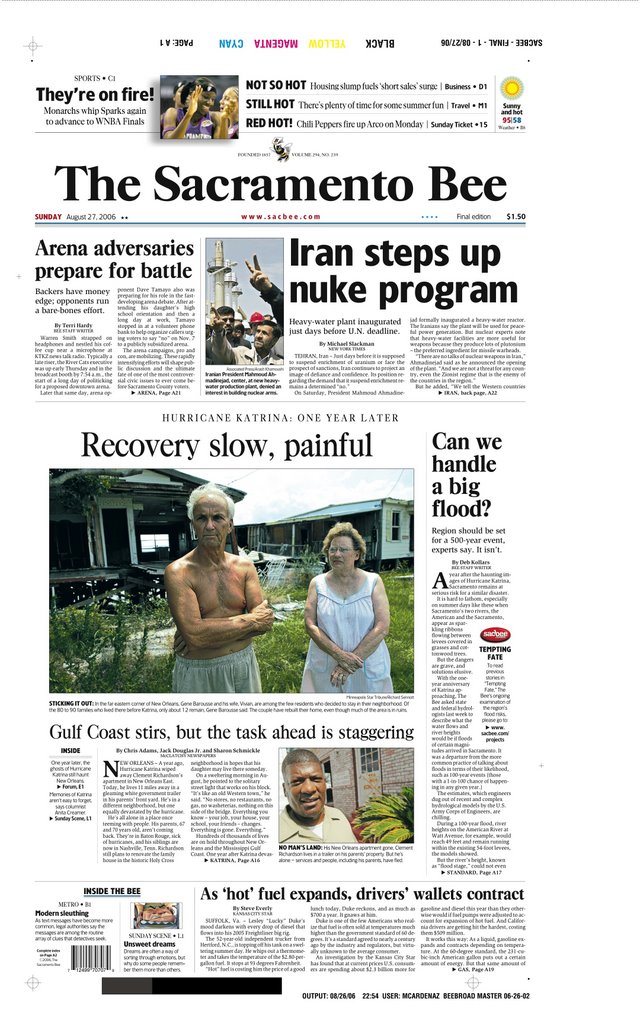
Kansas City's powerful "Hot Fuel" stories appeared around the country recently, provoking a storm of reaction. Among other readers was California's AG Bill Lockyear who (presumably) saw the A-1 story in The Sacramento Bee (pictured here) and ordered an investigation here in the nation's gasoline-thirstiest state.

I thought you'd be proud (as I was) to see this reaction, representative of what we're hearing from around the country. This testimonial is from Mark Lauffer, wire desk supervisor at the Arizona Republic:

I am in charge of wires for The Arizona Republic in Phoenix. I was blown away by your hot fuel series. When I pitched it to our editors last week, they were blown away, too. We ran it on Monday and Tuesday Aug. 28-29 on the front page. On Monday it was the lead story / centerpiece, above the fold. We a photo and graphic on the cover and another graphic inside. On Tuesday, we did an Arizona reaction piece to go with your story and we used another photo and graphic. By the way, the graphics showing how hot fuel works and how the pumps would work were outstanding.

I see on the wires that hot fuel already is becoming a campaign issue in Missouri. You and your staff may end up affecting millions of Americans.

What better journalism is there? When I pitched the story, I said it could be the best piece of consumer reporting I had ever seen.

–Howard Weaver

Thursday, August 24, 2006


Should we broadcast news on the web?

I met last week with the founder of an internet-based audio news service called the Quality News Network. This embryonic outfit consists of about a half-dozen journalists in Monterey, CA who write and present an hourly news report intended to serve as a more substantive alternative to network radio. They also do interview programs, candidate interviews and the like.

They want some kind of relationship with us. At the simplest level, we might link to (or otherwise implement) their newscasts from our websites, adding an audio component and, presumably, some advertising opportunities.

If you get a chance, go to Quality News Network and listen to a little of their work. Let me know if you think it's the kind of thing that would enhance your website.
–Howard Weaver

Sunday, August 20, 2006

Linking Raleigh and Charlotte

Ted Vaden, the News & Observer's excellent public editor, has a piece today that describes increasing cooperation between the N&O and their new cousins in Charlotte. He also asks whether this will be good for readers and decides that it probably will be, in the main.

We'll be talking a lot about sharing and cooperation in Ft Worth Tuesday. You might want to look at the Vaden column here.
–Howard Weaver

Saturday, August 19, 2006


Pew survey on the press

This detailed Pew study on how people get news and what they think about it was released July 30, but I just came across it. On first blush it seems to like their analysis is fairly predictable and occasionally superficial.

The lead breathlessly reports that 10 years ago only one in 50 Americans read news on the internet. Hell, 10 years ago even people that knew about the internet were lsitening to AOL busy signals on 1200-baud dial-up. I also don't find it illuminating to know that in 1965, 71 percent of news consumers read the paper; what else were we going to do?

But there's clearly a wealth of detail in the subsequent section about attitudes, media credibility (WSJ was most credible newspaper) and the like. I'd love to hear what you found most interesting.
–Howard Weaver
NABJ recruiting report

I joked with some of you that for some reason, I had never been as popular at ASNE as I was at this year’s convention.

Judging from our reception at NABJ in Indianapolis this week, the same is true for our whole company. Although attendance at the convention and recruiting fair were down and the total number of interviews reduced, I had more inquiries from experienced, talented journalists than ever before.

There were Blackberry-based scanners that let us record barcodes from name badges of applicants, so we should have a fairly comprehensive database of names from our walk-up traffic. Many candidates were interviewed by only one or two of us, of course, so it may be a little harder to get details on everybody, but we’ll work to gather that info, as well.

We had a couple of corporate folks and recruiters from Miami, Ft Worth, Kansas City, Raleigh, Columbus, Tacoma, Myrtle Beach, Belleville, Charlotte, Wichita and probably somebody I forgot (sorry). All did yeoman duty on the floor and in the hallways. How they did at the parties remains unreported.

This was my first experience working with Knight Ridder’s super-rep Reggie Stuart, who worked hard and well on our behalf. He’s a legend in recruiting circles, for good reason, and it was a pleasure to have his assistance.

We’ll talk some in Ft Worth Tuesday about opportunities. We need to be sure we capitalize on them all.
–Howard Weaver

Wednesday, August 16, 2006

Shashank Bengali,
interviewing in Ethipoia


Meet your correspondent

There's a nice interview online at the South Asia Journalists Association with McClatchy Africa correpsondent Shashank Bengali, who has lately been one of our team covering war in the Middle East.

I haven't met Shashank yet, and found the story illuminating. I think you'll find some insight here into the dedication our folks are bring to their work overseas. You can read the whole piece here.

Tuesday, August 15, 2006

Football, anybody?

I happen to know that at the News & Observer it's called High School Huddle. What's special about local football coverage at your paper? (Are you listening, Ft. Worth?)
–Howard Weaver
Be the clearninghouse

This post was adapted from a comment I shared on the new editorial page editors listserve:

Like many of you, I started a local community columnist rotation while I was EPE in Anchorage. (We called it "Compass: points of view from our community." Clever, huh?) It's still running and while I assume it is still as big a pain as it was back then, to my occasional eye it still looks like a valuable addition.

One huge difference between now and the Olden Days when I was editing: blogs.

There is a lot of spirited, robust local opinion being written in your communities, whether you know it or not. Much of it would not meet your standards for publication, but even in its more extreme iterations, it's indicative of local passion and engagement you need to be aware of. If you're not plugged into the local blogosphere, somebody on your staff damned sure better be.

I have seen some prototypes of a very promising effort at Sac Bee to make the opinion page's web presence a clearinghouse for local opinion blogs. As the leading media company in your community, you need to be the one-stop shop people turn to for pointers to such items. With few exceptions, it will be to our advantage to be the place where people come to explore local commentary ... even when the commentary itself sometimes comes in packages we wouldn't otherwise endorse.

When David feels ready, I hope he'll open that experiment up for you all to see.

Yes, this will be tricky. But I think it's essential. If you don't fill this need, somebody else will, and your own voice will be increasingly marginalized.
– Howard Weaver
The art of talk

I have long thought there was much for us to learn from ESPN.

The network doesn't do everything well; despite some exceptions, it isn't much for investigative journalism, for example. It seems tone deaf on occasion, as when it allowed Barry Bonds unfettered air for his point of view while controversy swirled around him everywhere else.

But as a demonstration of enthusiasm and focused energy, it has no peer. There's a palpable sense of fun in every Sports Center broadcast, of staffer's expertise and deep knowledge, of precision calibration of what the audience wants.

I wish our sports sections had half the energy and excitement.

Now there's an intriguing story from NPR about another enviable aspect of ESPN: the training course it mandates to teach staffers how to interview.

Nut graph:

Now, every single editorial employee at ESPN is expected to attend a three-day seminar, where they encounter a lanky, slightly awkward 58-year-old man with little flash. In his efforts to illustrate what he considers the "seven deadly sins of interviewing," John Sawatsky methodically eviscerates the nation's most prominent television journalists.

"I want to change the culture of the journalistic interview," Sawatsky says. "We interview no better now than we did 30 years ago. In some ways, we interview worse."

You can read a transcript of the David Folkenflik story (and listen to some audio about interviewing technique) at this link.
–Howard Weaver

Monday, August 14, 2006

Assault on the press

We've talked some here about the corrosive effect created by constant attacks on press. The noise machine powered by ideological bloggers, hysterical talk show hosts and partisan news organizations trumpets our failings (real and imagined) 24/7.

But the bigger threat by far comes from a much more potent source: the government of the United States. New Yorker editor David Remnick does a fine job of detailing that in a brief Talk Of The Town piece you can find here.

Here's a frightening sample:

In the past six years, the Administration and its surrogates have issued a stream of disinformation about intelligence an Iraq; paid friendly “columnists” like Armstrong Williams and Maggie Gallagher tens of thousands of dollars to parrot the White House line; accredited to the White House press corps a phony journalist and ex-prostitute (Jeff “Bulldog” Gannon, a.k.a. James Dal Guckert) as a reliable pitcher of softball questions; tightened Freedom of Information Act restrictions; and pioneered a genre of fake news via packaged video “reports.” The President has held fewer solo news conference than any of his modern predecessors The Vice-President kept the Times reporter off his plane because he didn’t like the paper’s coverage...

I was raised in the "never let 'em see you sweat" era of newspapers. "We stand by our story," you said in public. On a panel discussion you might venture as far as, "The journalism speaks for itself."

That's not cutting it any more. It's past time to fight back.
–Howard Weaver

Sunday, August 06, 2006

About trust and transparency

Here's a link to a story from AP about the survey that found half the adults in America believing that there were WMDs in Iraq just before our invasion.

My own view is reflected in this quote:
"I'm flabbergasted," said Michael Massing, a media critic whose writings dissected the largely unquestioning U.S. news reporting on the Bush administration's shaky WMD claims in 2002-03.

"This finding just has to cause despair among those of us who hope for an informed public able to draw reasonable conclusions based on evidence," Massing said.

So, what are we going to do about this?

We talked about transparency and wasy to "build and maintain reader trust" at a McClatchy meeting about a year ago. I made some notes about ideas that surfaced, including these:

• Greater transparency however possible
o Invite readers to a-1 budget meetings
o Pubish statement of purpose regularly
• On front page?
o Ask readers to hold us accountable
o Public editors
o Accuracy questionnaires
• Use web as authentication (eg publish transcripts, back-up documentation for controversial stories)
• Find ways to talk with readers when there’s no current crisis or problem
• Webcast endorsement interviews at editorial board?
• Tell readers about news staff credentials (house ads? Bio blurbs?)
• Use the “how we got this story” form to explain our process more often
Are you doing or thinking about other things that could help?

–Howard Weaver

Wednesday, August 02, 2006

McClatchy President's Awards

We've just announced the results of the competition for McClatchy President's Awards for the first half of 2006 – a period that obviously covered only the "McClatchy Classic" papers, but which I thought would be of interest to you all. I thought this was a particularly broad and strong set of winners.

Results are posted at www.mcclatchy.com under the "Newspapers" drop-down menu. Here's a summary from the press release:

SACRAMENTO, Calif., Aug. 2, 2006 – McClatchy President’s Awards for excellence have gone to eight different organizations in recognition of superior work in the first half of 2006.

Three of the award winners were powerful examples of reporting that holds government accountable and brings needed change. The Merced (Calif.) Sun-Star’s uncovering of abuses by the county district attorney; exposure of a questionable program that lets some defendants substitute charitable contributions for jail time in the Tri Cities in Washington state; and a comprehensive, condemnatory report on untested, unsafe water wells by The News & Observer in Raleigh, N.C., were all honored by the judges. In each of those cases, substantial change came about as the result of their journalism.

Two winners were praised for powerful storytelling: a dramatic series about a tragic shipwreck in Alaska, and a touching portrait of cloistered nuns in Fresno won for the Anchorage Daily News and The Fresno Bee.

A McClatchy Washington Bureau reporter and a Minneapolis Star Tribune photographer were honored for telling about how the economic fortunes of Axochiapan, Mexico, are entwined with the Twin Cities; and a Minneapolis reporter and photographer also won for their gripping, real-time account of the separation of cojoined twins at the Mayo Clinic.

The Sacramento Bee’s website also won a President’s Award for an extensive redesign that judges said greatly enhanced its journalistic presentation and helped ensure that online operations stay in touch with the way audiences choose to access information.

By way of background to those of you unfamiliar with the contest, it's a free-form exercise designed solely to recognize excellence. There are no categories, no circulation size classifications, no established number of winners. Here's a summary of info that I usually send to the judges (from outside the company) to explain our intentions:
The contest is open to all 12 McClatchy dailies and their websites. Whether an entry is a humor column, government investigation or web feature, it is judged on a single, subjective criterion: does it represent the highest levels of journalistic quality and excellence to which we aspire at McClatchy?

The papers compete to reach that standard, not against one another. Beaufort, with 12,000 circulation, isn't expected to match the resources Minneapolis brings to bear. In theory, every paper could win -- or none could. In practice, we generally come up with six or eight fine entries that win recognition.

The fact that our award is so entirely subjective and qualitative
underscores the need for judges who themselves embody solid journalistic judgment and high standards ...

So, will we be continuing the contest for all 32 papers in the future? I believe the answer is yes, though I haven't yet decided if we can do so in precisely this form. Our rules allowed a maximum four entries per paper and two per website, typically resulting in 50-60 entries. Do the math with 32 papers and the result (192!) seems unmanageable. We may need to refine the contest somehow.

Any ideas?
–Howard Weaver
5 true things about blogs

Reacting to Nicholas Lemann's recent New Yorker article about blogs, Steven "Everything Bad is Good for You" Johnson has written a funny piece suggesting five things that nobody ever needs to say about blogs-versus-MSM again.

You can find it here.
–Howard Weaver

Monday, July 31, 2006

Our Middle East reporting

Are you paying attention to the McClatchy Washington Bureau report from the Middle East? If you're not seeing these stories in your paper, please make sure you get a first-hand look on the wire or on the website here. You may want to find out why not.

From Hannah Allam, in Qana:

QANA, Lebanon - Many of the bodies were as tiny as dolls, with limp little fingers and debris that clung to their curls. They were killed in their sleep by an Israeli airstrike before dawn here Sunday, still dressed in action-figure pajamas and thin nightgowns.
–Howard Weaver

Saturday, July 29, 2006

An urgent, continuing discussion

There is something very important for those of us in the news business in the recent Harris Poll finding that half the adults in the country now believe there were weapons of mass destruction in Iraq when we invaded. To me, that and the related findings reported here are nothing less than a Red Alert for the Reality Community.

Here's a snip:

Despite being widely reported in the media that the U.S. and other countries have not found any weapons of mass destruction in Iraq, surprisingly; more U.S. adults (50%) think that Iraq had such weapons when the U.S. invaded Iraq. This is an increase from 36 percent in February 2005.


We have to figure out what this means. It's obviously a problem for us if people don't believe us; it's far worse news for the idea of democracy and self-government. If we can't get more than half the country to agree on the basic facts – not what to do about them, just what they are – there's no hope for civic conversation or shared decision-making. We'll never be able to solve problems if we can't agree on the vocabulary to describe them.

I don't have a definitive answer for this, but I know for sure it will involve the issues of trust and transparency we talk about all the time. We're going to talk about them even more.

I also suspect that it will end up turning on what people think of how we report the local news they know best. We once lost an important source for an investigative story in Anchorage because the woman wouldn't go on the record. Why not? Her husband had an odd last name that had been consistently misspelled by his local paper (not us) when he was a high-school football player, and he didn't trust the press to get things right.

Let's plan to introduce this discussion during our break-out session in Ft. Worth next month. It will be a brief and busy session with lots to cover, but this needs to be a constant and urgent discussion.
–Howard Weaver

P.S. For those who asked: Yes, I have been on vacaction. But there are lots of odd moments available even so. This comes during a layover in the San Diego airport with a decent wifi connection ...

Friday, July 28, 2006

Sifting mountains of information

Malcom Gladwell, author of "Blink" and innumnerable other smart essays and observations, has been widely castigated in the blogosphere for saying something like "without the New York Times, bloggers would have nothing to write about."

He didn't mean that bloggers never do good or original work. But he did mean to suggest that in the realms of public affairs, the good ole MSM does some important work. You can read his worthwile rebuttal to criticisms here.

Here's the money graph, in my opinion:

Has the level of self-regard in the blogosphere really reached such
dizzying heights that it can’t acknowledge the work that traditional media does on behalf of the rest of us? Yes, the newspaper business isn’t as lucrative as it once was (although it’s still pretty lucrative). And it doesn’t seem as exciting and relevant as it once was. But newspapers continue to perform an incredibly important function as nformational gatekeepers—a function, as far as I can tell, that grows more important with time, not less. Between them, for instance, the Times and the Post have literally hundreds of trained professionals whose only job it is to sift through the mountains of information that come out of the various levels of government and find what is of value and of importance to the rest of us. Where would we be without them? We’d be lost.

-Howard Weaver

Wednesday, July 26, 2006

Editor's blog at work

We had some good discussion here not long ago about the value of editor blogs versus the tendentious replies and extraneous comments they often evoke. All true, all worth pondering. But while there's plenty of that evident here, it's hard not to see the back-and-forth over Ander's blog about their dust-up with the Minnesota AG as a valueable contribution to that debate. In the old days, the paper likely would have said nothing in response to the AG's blast, or might have issued a short statement and let it go. The blog's more robust discussion is going to help the Strib, I think. You can read the post and extensive comments here.
-Howard Weaver

Tuesday, July 25, 2006

News from back home for newcomers
In Charlotte, we're interested in running something along the lines of a 50-state news summary. Other McClatchy papers in the Carolinas are also interested in a feature like that. We think this would be particularly sticky content for our region's newcomers. I know a lot of you also have lots of newcomers. The Associated Press does not move something like that. I'm told that the AP does assemble the one you see in USAToday, but for a special premium. I wondered if any of you have discovered a way to produce something like this without the AP's involvement.

Tuesday, July 18, 2006

What is this s---?

I remember the olden days, when the NYT famously did not print profanity, yet included some in the transcripts of Nixon's secretly recorded meetings. Somebody protested to Abe Rosenthal that the paper didn't seem to know its own policy, and he said, "I suppose the policy is that we'll take 'shit' from the president of the United States, but nobody else."

The Star Tribune, will, too. See Anders Gyllenhaal's blog note on the decision to use the quote here.

What did your paper do?
–Howard Weaver

Sunday, July 16, 2006

Journalism's happy ending?

William Powers, media critic at the National Journal, had a piece in the L.A. Times that's worth taking a look at. This was my takeaway:

If those old [media] outlets continue to offer strong, reliable journalism — a craft that's not as easy as it looks — they will survive. And if they fail, others will rise up to replace them. The new marketplace punishes errors, but it also rewards those who get it right. Increased scrutiny and skepticism will make the media stronger, not weaker.

You can read it all here.
–Howard Weaver

Saturday, July 15, 2006

When good blogs go bad


I've been doing a blog for almost a year and now am considering stopping or fundamentally changing my approach. Why? Over time I have determined that the blog doesn't do what I'd hoped -- it has not fostered a give and take about coverage with readers (including critics) of The N&O. Instead, it seems to have a mostly silent readership and few commenters, all anonymous, including a few who simply visit to throw grenades.

Lately, the blog has more or less been hijacked by some people -- mostly out of state commenters -- who think the Duke lacrosse players are innocent and that The N&O is to blame for their troubles. They don't appear to read our coverage and pay little attention to my responses to their questions/accusations. One particularly obsessed commenter, for instance, accuses us of taking our stories off the wire (the wire picks up our stories and she sees them elsewhere, so thinks we're taking from the wire)

I'm continuing to post on various topics, including Duke lacrosse coverage from time to time, while I think about whether this endeavor is worth continuing. Some change is in order. I don't have time to monitor comments or "police" the blog. Some of the comments, beyond their attacks on me, are reckless with facts and it concerns me that I am playing host to this level of junk.

Please share any suggestions or comments. (But for god's sake, use your name! :) )
Who cares about
local ownership?


Jay Rosen at PressThink has an interesting post criticizing a Forbes online column about local ownership of newspapers. Far more interesting, to me, is the whirlwind of comment that the post generated. Seems clear this is an issue of real moment for newspaper people. You might take a look here.
–Howard Weaver
Evolution, revolution
& hand grenades


Dean Singleton, sitting just to my right on a panel discussing “the future of news” at the AP Sports Editors convention last month, served up a fat pitch I just couldn’t resist.

As he so often has, Dean illustrated his call for fundamental change with the comment that, "We have to throw a hand grenade in the middle of the newsroom, blow the place up, and start over again." That gave me the opportunity to come out foursquare against murderous explosions aimed at our colleagues.

I don’t disagree about the imperative of fundamental change. I’ve been thinking about these issues since 1995, when I worked for Gary and had the somewhat grandiose title “assistant to the president for new media strategies.” We knew then and have become ever more urgently convinced that a digitally networked world changes everything.

Maybe Dean and others employ metaphors about hand grenades and revolutions simply to make the (correct) point that change is imperative. But I’m afraid they actually believe it, and that is dangerous and wrong.

The big mistake is assuming that fundamental change requires wrenching, violent revolution. Everything we know about life on earth tells us evolution is a better bet.

Revolutions generally (and hand grenades in particular) bring change indiscriminately. In rejecting the status quo, revolutionaries abandon institutions and disciplines that have evolved successfully after long testing and experimentation. These things usually became successful for a reason, and even if their time is past, the vacuum created by their absence isn’t likely to be pretty. Put it more simply: a revolution is far more likely to end up with the Reign of Terror than an Athenian Senate debate.

Critics say evolution is too slow and gradual to cope with rapid change. Not true.

While most people think of evolution as a sequence of minute changes iterated gradually over an unimaginably long time, it doesn’t usually work that way. As Stephen Jay Gould and others discovered, evolution is better understood as a process of punctuated equilibrium, where the equilibrium is long periods of stability and the punctuation is relatively rapid change and adaptation when required. (Gould’s book Wonderful Life, and especially his discussion of punctuated equilibrium in the Burgess Shale, is one of those books that changed the way I see the world).

In other words, evolutionarily successful organisms naturally carry on until conditions change, at which point they adapt pretty quickly to accommodate it.

Think newspapers.

There wasn’t a lot of imperative for newspapers to change when they had 80% reader penetration and 40% profit margins. Nestled securely in an evolutionary niche protected by geographic monopolies, exclusive classified advertising franchises and high barriers against competition, we ruled infoworld between WW2 to the internet.

Not now. The disruptive technologies born of digital networks have changed the climate, and the old order is no more. Change we must.

But our change will be more lasting and better constructed if we apply the time-tested lessons of evolution and eschew the flashier but less productive posture of revolution. As we apply lessons learned from the changing climate to adapt our sturdy, battle-hardened structures, we’ll end up with operations that meet changed conditions without abandoning valuable lessons from our past.

It’s hard for a hand grenade to make that kind of distinction.

I believe we’re smart enough and disciplined enough to pull this off – and with all you folks on the team, I’m ready to take on the hand grenade crowd any time, any place.
–Howard Weaver
Signals of fundamental change

Tim Porter notes in a First Draft post this morning that news companies' financial results and subsequent cutbacks are more than indications of capitalism at work in the boardrooms, They are also signals of the fundamental shift in how our audiences get and want to get their news.

For journalists working in newspaper newsrooms, consider these financial reports as a series of wake-up calls, the quarterly tolling of a bell that tolls for thee, my friends.

The digital newspaper future is already here - and it's not one most journalists would have invented, but if they don't seize control of the change process then someone else, someone from the boardroom, will do it for them.

I think he's absolutely right. He notes the recent Dow Jones strategic initiative that begins, "We live in a digital age that is fundamentally changing how people get their news and information," a memo worth reading over here at Poynter.

We've been saying a lot of this for some time now at McClatchy, and you'll be hearing a lot more in coming weeks. It's on the agenda for our first meeting joining editors from new McClatchy and McClatchy classic papers in South Carolina next week. We'll surely talk about it in Ft. Worth when we all gather next month. I hope many of you think contribute thoughts about it here, in comments and postings.

We need to be urgently engaged in this. Please join in.
–Howard Weaver

Tuesday, July 11, 2006

'Balance' is often insufficent

Dante Chinni, an associate at the Pew Center for Excellence in Journalism, writes here in the Christian Science Monitor about a journalism truism we probably all know but may sometimes neglect: "balance," no matter what they say on Fox News, is a simpleminded concept that doesn't begin to describe everything we're trying to do.

I heard Molly Ivins make the same point once, describing what she called "the discredited idea that the truth always lies somewhere halfway in-between competing points of view."

Well, it might, but it sure as hell doesn't always. We need to bring more to the party than the stenographic and telephonic skills involved in calling the usual suspects and accurately recording their assertions. In addition to balance, we look for fairness, verification, documentation and the like. We want to add more to a reader's understanding than she would get just listening in on the argument.

Our web publishing platform gives us great new tools to help do this. Publishing links to original source documents, video clips and transcripts of events (or even interviews), backstory reports form reporters on how they got the story ... all these things can add depth and credibility. All make our journalism much more than simply "balanced."
–Howard Weaver

Monday, July 10, 2006

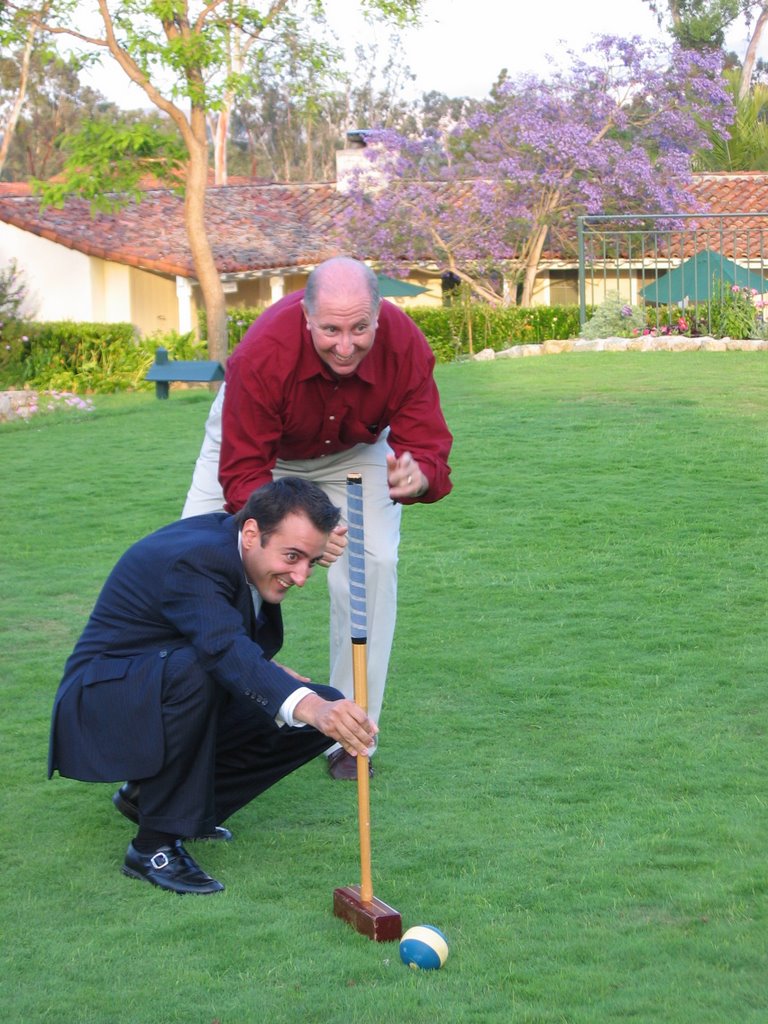
Out here in California's Central Valley, we have a pretty good kinship among the "three Bees" and the Merced Sun-Star. As if to illustrate the point, Modesto Bee Editor Mark Vasché at left helps Sun-Star Editor Joe Kieta line up a shot during a croquet match at a California Society of Newspaper Editors meeting. We're glad that the San Luis Obispo Tribune has joined the fraternity in California, and we welcome all the other newcomers to the McClatchy clan.

Saturday, July 08, 2006

Editor uses phrase 'value proposition'

Well, I can't believe it, but I actually did use the term "value proposition" in my little essay for Poynter about the future of news. And then they put it in the headline, no less.

Well, I apologize. In my defense, the essay was written in about an hour (they assigned us all that task at the conclusion of a recent seminar; other essays from that session – David Zeeck, Byron Calame, Wes Turner, Peter Bathia and more – are available here). And I did put the phrase in quotation marks, which kind of shows that I knew better.

But I wrote it, no denying that. I can only image the reaction I would have inspired from Jim McClatchy, who famously objected to anybody calling a newspaper a "product."

Nonetheless, I believe everything I said. You'll undoubtedly be hearing me same this and similar things again and again. I think it's important.
– Howard Weaver

Sunday, July 02, 2006


Thinking about Washington

I didn't do any kind of comprehensive survey, but cruising through your websites last week indicated that our Washington bureau integration and assumption of the former KRT duties have worked pretty well.

Tom Lasseter from Iraq was on the front of Mod Bee (and doubtless many others) on Sunday. Anchorage and Sacramento both used the China-Tibet railroad on A-1. Our Gitmo mainbar was the lead in Minneapolis and Miami. Lesley Clark's regional on offshore drilling was splashed across the top of A-1 in Bradenton and a David Whitney piece on drilling in California was the local lead in the Tribune in SLO. Henderson's SCOTUS overview was on the front in Macon. Mark Vasche's column and the lead edit in the Centre Daily Times Sunday both talked about improvements in Washington and foreign coverage and how excited they are about the new bureau.

Our Washington operation will be the focus of a great deal of attention in coming weeks. In some ways, it's the most visible, highest profile illustration of how the entire McClatchy/KRI integration is working. Our judgments about journalism will be noted, and no doubt critiqued. People will be watching especially closely to the jobs we fill, the assignments we change, and whatever else may come.

And, of course, there's a pretty tough bunch of critics here in the family. Our overarching objective for Washington is that it make your news products better: in print and online, wholesale and retail, at home and abroad. You're the customers who matter most.

If the bureau and MCT are delivering what you want and need, for God's sake use them. And if they're not, tell David, John and Jane what your concerns are. Maybe what you're after is a key we can use to make everything better; maybe you're wrong and we need to start that discussion instead. In either case, we won't know until we start the conversation.

And as Casey Stengel used to say, include me in. We're spending a great deal of money and energy to get this right. It's my job to make sure we do.
– Howard Weaver

Thursday, June 29, 2006

Getting to know you

In California, the three Bees have long referred to one another as "cousins," as in "I wonder if one of the cousins is going to cover this?" It's always seemed like a useful, friendly construct to me.

Well, we've all got a lot more cousins now. I thought it might be fun to share a few images here to help us identify with and understand one another better.

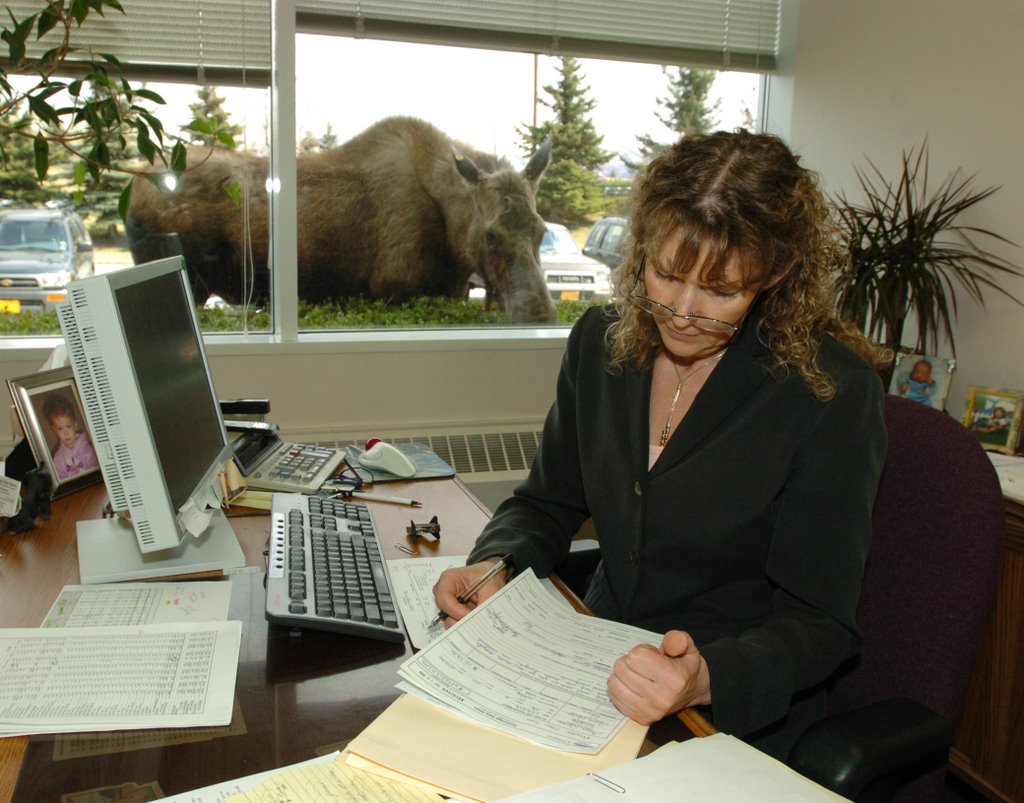
Pictured here is a woman working in the finance office at the Anchorage Daily News, a place where I worked more or less from high school until middle-age. This was taken a month or so ago, I am told. Moose are common visitors there, although more likely in winter, when deep snow in the mountains forces them to look for something to eat in your rose garden.

You have anything to share?
– Howard Weaver

Wednesday, June 28, 2006

New media isn't new any more

There is a short post here that makes a point that has seemed more and more important to me lately: we need to stop thinking about "print media" and "new media" and all such other constructs and start acting like it's all just media.

The commentator at techdirt (I have no idea what that is) put it this way:
These companies don't need Chief Digital Officers. It's not a separate job function. They need to get the entire company thinking digitally and understanding how it impacts their business.
I had the same thought recently in making a presentation to a strategic planning session at Sac Bee. I had a job here 11 years agoi called "assistant to the president for new media strategies." Dumb title, I realize, but at least it was accurate then. The digital stuff really was new media then. It's not new any more.

I had the same thought again yesterday when Kit Seelye from NYT was here interviewing some of us for her ticktock on the deal. It's so clear to me now that our whole strategy is easily ecapsulated in the simple objective: "be the leading local media company."

In our case, news media, since we aren't [yet] aiming at Disney or Sony. But when it comes to news, we want to master all media, to be fully engaged and present in instant-cycle 24/7 breaking news (online, email alerts, RSS, etc); in comprehensive printed daily briefing/orientation in the mainsheet newspaper; in video and podcasting selectively; in foreign language and other niche publications.

It's all just media. And you are in the media business.
– Howard Weaver

Monday, June 19, 2006


What happens to KRT?

The day McClatchy's acquisition of Knight Ridder closes (likely to be June 27, if all goes according to plan), KR's half-interest in Knight Ridder Tribune Information Services also changes hands. We will become 50-50 partners with Tribune in the enterprise.

The name will change. For the time being, at least, all we are doing is substituting our name for Knight Ridder's, as in the logo above. In the same way that KRT was known by its three initials, we plan to brand this MCT. (We thought about simply MT, but that has problems. Say it aloud a couple of time: Em-Tee, Em-Tee. We also thought that McT -- Mac-Tee -- sounded too much like a fast food product.) The logos and website designs will be tuned to look like the KRT trademarks to help ensure continuity of branding and recognition.

Most importantly, the high-quality content and professional service will remain the same. Some of you know that McClatchy's contractual relations as a contributor to the New York Times News Service and Scripps-Howard News Service create some complications with regard to distribution through MCT. While we are sorting that out, we have agreed with NYTNS that the 20 former KR papers will continue to contribute through MCT, while the 12 legacy McClatchy papers will keep contributing to NYTNS and Scripps.

We have also invited most of the divested KR papers to continue contributing and receiving the wire, and I expect they will. Thus KRT clients who were accustomed to seeing Philadelphia or San José stories should continue to have them. Jane Scholz and her fine staff in DC continue as before.

Of course there will be changes. The existing McClatchy papers (who were already KRT's largest customer) will get access to more of the service; somebody from the service will be contacting them about that. Distribution will change in the Twin Cities. We will have to work through which channels handle contributions from bureau staffers.

If you spot or foresee problems or anomalies, please flag them for me, Jane or David Westphal. Thanks.

– Howard Weaver

Thursday, June 15, 2006

Untitled

Does blogging make reporters better?

That's one question asked in an interview with Tacoma's award-winning sportsblogger Mike Sando over at the Online Journalism Review. (One question we can answer authoritatively is that great reporters can make great bloggers. Mike proves it.)

You can find the article on Sando's Seahawks blog here.

– Howard Weaver

Washington Post columnist Matt Cohen has written a column about the value of news vs. the value of newspaper companies to Wall Street.

I think he's right on target when he states, "... while (Morgan Stanley's Hassan Elmasry) mentions benefit to 'shareholders,' he says nothing about readers or, if you will, the public in general. 'Intrinsic value,' after all, should not always be measured in monetary terms."

I am starting to feel like Howard Beale in Network: "I'm mad as hell, and I'm not going to take this anymore!"

All industries undergo change. The strong survive; the rest are relegated to history books. Our industry is changing in many ways, but our core values are no different - or they shouldn't be, regardless of what Wall Street says. It is insane to me that an industry that regularly manages profit margins of 10%, 20%, 30% - even 40%! - gets trashed by "analysts." How many other industries in the world's richest nations wouldn't kill for profit margins of 10%? The world is upside down. Granted, I'm in a midsized market and have watched the nightmares of San Francisco's circ declines from a distance. But I think there are a whole lot of newspaper folks across the country who are reading the industry's obituary and scratching their heads, wondering how it could possibly apply to their situations.

I was watching a favorite movie the other night, Apollo 13, and one sequence in particular made me think of our industry: A couple of pencil-pushing geeks are worried the astronauts will die and say, "This could be the worst disaster NASA has ever faced." The character played by Ed Harris turns to them with full confidence and says, "With all due respect, sir, I believe this is going to be our finest hour."

-- Andy Perdue

Tuesday, June 13, 2006

Better than investigative reporting?

Hunting down bad guys and exposing corruption will always be a central mission for journalists. But will it always be the most important one? Is it now?

Matt Thompson argues in "The Press' New Paradigm" that helping people grasp the meaning of the complex information that defines contemporary life may be the highest calling for journalists these days. In an age when Enron's misdeeds went unchallenged because they were buried in complexity few could penetrate, he may have a point. I read a book not long ago called "Data Smog" that makes the telling point that bad information -- like polluted air -- can be toxic.

I encourage you to click through to Matt's essay and then come back for some discussion in the comments here. These are important questions.

But data modeling instead of gumshoes? Man, talk about revenge of the nerds.

– Howard Weaver

Friday, June 09, 2006

Quote of the day ...

Stolen from a New Yorker cartoon and overheard at a CSNE workshop called "Newsroom Reformation":

"Okay, I'm ready to innovate. What are the guidelines?"

– Howard Weaver

Clear choices in an uncertain time

I gave a short talk and answered questions this morning at the California Society of Newspaper Editors gathering in Santa Barbara, where I was asked to address both the McClatchy/Knight Ridder deal and the future of newspapers.

Attendance was lighter than usual (isn't that true at all newspaper meetings nowadays?) but there was a good representation from papers large and small throughout the state. I was happy to see Sandra Duerr and Tad Weber from San Luis Obispo amongst some familiar faces from Modesto, Sacramento and elsewhere. I was able to take in an excellent presentation on how California newspapers are using video online, including some impressive samples from small, rural papers.

I doubt there's much in my remarks you don't know or haven't heard, but what the heck; I already wrote this, so I'm going to post it here:

Remarks for CSNE Convention * 9 June 2006
Howard Weaver * Santa Barbara, CA


Some of you have already heard the story of how McClatchy’s involvement with the Knight Ridder acquisition began. We can date it almost to the moment, starting at lunchtime on November first, 2005 – a warm day in Sacramento with a small group of McClatchy executives sitting at a sidewalk table having lunch. At some point in the proceedings, CFO Pat Talamantes glanced down at his Blackberry and then stood up to leave. He read us the email from Gary Pruitt: “Knight Ridder in play. Let the games begin.”

The prospective end of Knight Ridder’s long and storied history and the beginning of McClatchy’s new adventure are not, of course, all “games.” But there is no denying that a thrill of excitement infused our discussions that afternoon, and animated the long days of hard work between that afternoon and this morning.

I heard Gary Pruitt tell Tony Ridder and his executive team in San Jose one afternoon that McClatchy’s first choice would be that Knight Ridder not be forced to sell. We believe in independent newspaper companies, and like everybody in our industry, we knew and admired what those newspapers have accomplished over many decades. It’s never a good thing for a great newspaper company to go away.

But I also heard Gary say and know that we all strongly believed that if the company was to be sold, we wanted very much to be in the hunt.

You probably know that McClatchy’s acquisition strategy has always been tightly focused and very disciplined. We look at practically every opportunity that comes into play, but we act on almost none. We had purchased the Raleigh News & Observer in 1995, the Minneapolis Star Tribune in 1998, and the Merced Sun-Star in 2004. In between were long, patient periods of saying no, of passing on one opportunity after another. We were a successful company as we were, and knew we didn’t have to grow to prosper.

But now, with the Knight Ridder sale, we were looking at the prospect of not one or two or even a half-dozen possibilities: there might be 15 or 20 opportunities here that matched our market-centered acquisition criteria. We started studying them with real excitement.

Much has been written about our decision to keep some of the Knight Ridder papers, and to sell others. I know it surprised and even shocked many in our industry, but it really shouldn’t have. McClatchy has always said that it had a strict acquisition criteria, and would apply it with discipline. So when the time came and we applied our strict criteria in a disciplined way, it really should have come as no surprise.

People typically write that McClatchy is interested only in growth markets, and while it is true in a broad sense that growth is key, that certainly doesn’t fully describe our process. If it did, anybody could duplicate it: just call up the Census Bureau, get the numbers and start writing checks.

We’ve said a number of times that the analysis actually involves a wide range of factors: household growth, retail sales, education, propensity to read and many others. We don’t describe it in detail because it’s proprietary information. I’d argue that we have been pretty successful in our acquisitions to date, and this formula is, in a way, our Secret Sauce.

What took some of the observers by surprise, I suspect, is that we analyzed Knight Ridder not as a single monolithic entity, but market by market. We ran hundreds, perhaps thousands of econometric models predicting what would happen under the broadest range of conditions: what if there was another recession? Would this roster of markets still generate the cash flow to pay the debt? What if there was a terrorist attack, or an influenza pandemic. I heard Gary say once that we had modeled everything this side of a direct hit by an asteroid.

In the end, we were thrilled to find 20 of Knight Ridder’s markets matched our criteria nearly perfectly. But the other 12 did not, and most of the stock analysts and investment bankers who got quoted assumed we wouldn’t be willing to buy and immediately sell them on account of what they call “tax leakage.” As Gary’s pointed out, we just call that “paying our taxes,” and we were willing to do so as a part of our larger plan for doing the deal.

As I have told folks in Philadelphia and San Jose, we clearly were not selecting a journalistic all-star team; if we were, those papers surely would have been included. What we did instead was pick the markets where we thought our established, tested strategy would work. It’s what we know how to do, what defines our company. Other companies have other strategies and operating styles; they are not necessarily better or worse, they are different.

We know, like all of you, that the economics of the news business are changing, and that the margin for making mistakes has become much smaller. Where dominant daily newspapers used to be something very much like a license to print money, there are now distinguished, big-city papers losing lots of money.

Equally threatening is the fact that our relationship with our readers is changing. Our credibility is under assault on all sides – from talk radio, and bloggers, from political parties and the government of the United States. Partisan advocacy and ideology – the Journalism of Affirmation – threatens to take the place of our longstanding ambition: a journalism of verification, based on fair, honest, fearless newsgathering and truthtelling.

In other words, the stakes are very high. In seeking the create a 21st century news company – one that serves diverse audiences on many platforms, when and how they want to access us – we needed nothing less than the strongest team we could field.

Today we are earnestly and diligently engaged in just that pursuit: in Modesto and Merced, in Raleigh and Rock Hill. Soon, we hope, our team will be joined by colleagues in San Luis Obispo and Miami and State College, PA.

We know the battle is not ours alone; newspapers across the country are awakening from their slumber to embrace the opportunities and challenges we have described. More and more editors have rallied to the battle cry of ASNE President David Zeeck, who said: “I'm not spending another minute of my life worrying about the future of newspapers … I believe in newspapers and I believe they will last. But I also believe in the web. Heck I'm willing to believe in iPods and cell phones. Really what I'm saying is I believe in journalism.”

And if newspapers don’t defend journalism, who will? We know no other media have the will or the wherewithal to advance our central values into the new media landscape. In each of your communities, you should have the largest news staff, the leading website, the most ad salesmen and the best reputation. We still making good money, and have resources to invest.

I cannot guarantee you success, though in my heart I truly do expect us to prevail. But I can offer you the satisfaction of a choice well made.

For what are the choices for an honest journalist today? I can think of three.

We can give up.

We can hunker down and try to bleed as slowly as possible.

Or we can fight back.

I have not one moment’s doubt about those choices.

– Howard Weaver

Monday, June 05, 2006

New press, new look in Kansas City

Today's a big day for the Kansas City Star. The full-dress version of their redesign hit the streets this morning.

As you probably know, this coincides with operations at the new state-of-the-art pronting facility you see pictured at the top of the page to the right. The handsome, downtown facility is gorgeous, modern and oh-so functional, providing both visual and financial proof of their faith in the role printed newspapers will continue to play.

At the same time, of course, the Star is at the fore in finding other channels for delivering information audiences need, including frequent video coverage at kansascity.com.

– Howard Weaver

Sunday, June 04, 2006

Could less competition be better?

Amy Graham has a post over at Poynter that dares to suggest there might be something to the agrument that competition isn't always the best thing for media.

At first blush the argument is anathema to those of us weaned on the ethic and exhilaration of completive newsrooms. I know for certain that the desire to kick the ass of whoever was covering my beat for the rival Anchorage Times motivated me more often than any deep, selfless desire to serve the public good. It kept me at the desk and on the phone late, steeled my nerves to knock on strange doors, made me double and triple check the factoids.

But Amy and others whose arguments she incorporates make some telling points. Could it be that times and circumstances have changed so much that we need to rethink the truism?

In an age of blogs and 24-hour cable and instantaneous updates on dozens of media websites, does it make sense for everybody to staff the daily White House briefing? How important is it for journalists from half our papers to staff the Super Bowl? Is your art director’s take on the Oscar preview page really that much better than the half-dozen others you could use from somebody else?

Suppose you could take the resources you’d save by skipping all that and devote them to something unique, particular and compelling? An investigation into college recruiting in your town, rather than game stories from every road trip of the Anytown Warriors; a unique graphic explanation of a controversial area shopping mall proposal, rather than that generic Oscar page; a close look at Pentagon procurement practices by Congressional district instead of a story that matches what the NYT, LAT, AP and Reuters all had from the briefing?

As we start to integrate 32 papers into the new McClatchy, these questions will become more sharply framed. Think about what you could do to optimize the resources in your newsroom by using something produced by a cousin. Think about what you can contribute to help them.

I don’t think there’s a one-size-fits-all answer here. But I am betting we will find more and more occasions where these questions matter.
– Howard Weaver
 
/*