Wednesday, August 02, 2006

McClatchy President's Awards

We've just announced the results of the competition for McClatchy President's Awards for the first half of 2006 – a period that obviously covered only the "McClatchy Classic" papers, but which I thought would be of interest to you all. I thought this was a particularly broad and strong set of winners.

Results are posted at www.mcclatchy.com under the "Newspapers" drop-down menu. Here's a summary from the press release:

SACRAMENTO, Calif., Aug. 2, 2006 – McClatchy President’s Awards for excellence have gone to eight different organizations in recognition of superior work in the first half of 2006.

Three of the award winners were powerful examples of reporting that holds government accountable and brings needed change. The Merced (Calif.) Sun-Star’s uncovering of abuses by the county district attorney; exposure of a questionable program that lets some defendants substitute charitable contributions for jail time in the Tri Cities in Washington state; and a comprehensive, condemnatory report on untested, unsafe water wells by The News & Observer in Raleigh, N.C., were all honored by the judges. In each of those cases, substantial change came about as the result of their journalism.

Two winners were praised for powerful storytelling: a dramatic series about a tragic shipwreck in Alaska, and a touching portrait of cloistered nuns in Fresno won for the Anchorage Daily News and The Fresno Bee.

A McClatchy Washington Bureau reporter and a Minneapolis Star Tribune photographer were honored for telling about how the economic fortunes of Axochiapan, Mexico, are entwined with the Twin Cities; and a Minneapolis reporter and photographer also won for their gripping, real-time account of the separation of cojoined twins at the Mayo Clinic.

The Sacramento Bee’s website also won a President’s Award for an extensive redesign that judges said greatly enhanced its journalistic presentation and helped ensure that online operations stay in touch with the way audiences choose to access information.

By way of background to those of you unfamiliar with the contest, it's a free-form exercise designed solely to recognize excellence. There are no categories, no circulation size classifications, no established number of winners. Here's a summary of info that I usually send to the judges (from outside the company) to explain our intentions:
The contest is open to all 12 McClatchy dailies and their websites. Whether an entry is a humor column, government investigation or web feature, it is judged on a single, subjective criterion: does it represent the highest levels of journalistic quality and excellence to which we aspire at McClatchy?

The papers compete to reach that standard, not against one another. Beaufort, with 12,000 circulation, isn't expected to match the resources Minneapolis brings to bear. In theory, every paper could win -- or none could. In practice, we generally come up with six or eight fine entries that win recognition.

The fact that our award is so entirely subjective and qualitative
underscores the need for judges who themselves embody solid journalistic judgment and high standards ...

So, will we be continuing the contest for all 32 papers in the future? I believe the answer is yes, though I haven't yet decided if we can do so in precisely this form. Our rules allowed a maximum four entries per paper and two per website, typically resulting in 50-60 entries. Do the math with 32 papers and the result (192!) seems unmanageable. We may need to refine the contest somehow.

Any ideas?
–Howard Weaver
5 true things about blogs

Reacting to Nicholas Lemann's recent New Yorker article about blogs, Steven "Everything Bad is Good for You" Johnson has written a funny piece suggesting five things that nobody ever needs to say about blogs-versus-MSM again.

You can find it here.
–Howard Weaver

Monday, July 31, 2006

Our Middle East reporting

Are you paying attention to the McClatchy Washington Bureau report from the Middle East? If you're not seeing these stories in your paper, please make sure you get a first-hand look on the wire or on the website here. You may want to find out why not.

From Hannah Allam, in Qana:

QANA, Lebanon - Many of the bodies were as tiny as dolls, with limp little fingers and debris that clung to their curls. They were killed in their sleep by an Israeli airstrike before dawn here Sunday, still dressed in action-figure pajamas and thin nightgowns.
–Howard Weaver

Saturday, July 29, 2006

An urgent, continuing discussion

There is something very important for those of us in the news business in the recent Harris Poll finding that half the adults in the country now believe there were weapons of mass destruction in Iraq when we invaded. To me, that and the related findings reported here are nothing less than a Red Alert for the Reality Community.

Here's a snip:

Despite being widely reported in the media that the U.S. and other countries have not found any weapons of mass destruction in Iraq, surprisingly; more U.S. adults (50%) think that Iraq had such weapons when the U.S. invaded Iraq. This is an increase from 36 percent in February 2005.


We have to figure out what this means. It's obviously a problem for us if people don't believe us; it's far worse news for the idea of democracy and self-government. If we can't get more than half the country to agree on the basic facts – not what to do about them, just what they are – there's no hope for civic conversation or shared decision-making. We'll never be able to solve problems if we can't agree on the vocabulary to describe them.

I don't have a definitive answer for this, but I know for sure it will involve the issues of trust and transparency we talk about all the time. We're going to talk about them even more.

I also suspect that it will end up turning on what people think of how we report the local news they know best. We once lost an important source for an investigative story in Anchorage because the woman wouldn't go on the record. Why not? Her husband had an odd last name that had been consistently misspelled by his local paper (not us) when he was a high-school football player, and he didn't trust the press to get things right.

Let's plan to introduce this discussion during our break-out session in Ft. Worth next month. It will be a brief and busy session with lots to cover, but this needs to be a constant and urgent discussion.
–Howard Weaver

P.S. For those who asked: Yes, I have been on vacaction. But there are lots of odd moments available even so. This comes during a layover in the San Diego airport with a decent wifi connection ...

Friday, July 28, 2006

Sifting mountains of information

Malcom Gladwell, author of "Blink" and innumnerable other smart essays and observations, has been widely castigated in the blogosphere for saying something like "without the New York Times, bloggers would have nothing to write about."

He didn't mean that bloggers never do good or original work. But he did mean to suggest that in the realms of public affairs, the good ole MSM does some important work. You can read his worthwile rebuttal to criticisms here.

Here's the money graph, in my opinion:

Has the level of self-regard in the blogosphere really reached such
dizzying heights that it can’t acknowledge the work that traditional media does on behalf of the rest of us? Yes, the newspaper business isn’t as lucrative as it once was (although it’s still pretty lucrative). And it doesn’t seem as exciting and relevant as it once was. But newspapers continue to perform an incredibly important function as nformational gatekeepers—a function, as far as I can tell, that grows more important with time, not less. Between them, for instance, the Times and the Post have literally hundreds of trained professionals whose only job it is to sift through the mountains of information that come out of the various levels of government and find what is of value and of importance to the rest of us. Where would we be without them? We’d be lost.

-Howard Weaver

Wednesday, July 26, 2006

Editor's blog at work

We had some good discussion here not long ago about the value of editor blogs versus the tendentious replies and extraneous comments they often evoke. All true, all worth pondering. But while there's plenty of that evident here, it's hard not to see the back-and-forth over Ander's blog about their dust-up with the Minnesota AG as a valueable contribution to that debate. In the old days, the paper likely would have said nothing in response to the AG's blast, or might have issued a short statement and let it go. The blog's more robust discussion is going to help the Strib, I think. You can read the post and extensive comments here.
-Howard Weaver

Tuesday, July 25, 2006

News from back home for newcomers
In Charlotte, we're interested in running something along the lines of a 50-state news summary. Other McClatchy papers in the Carolinas are also interested in a feature like that. We think this would be particularly sticky content for our region's newcomers. I know a lot of you also have lots of newcomers. The Associated Press does not move something like that. I'm told that the AP does assemble the one you see in USAToday, but for a special premium. I wondered if any of you have discovered a way to produce something like this without the AP's involvement.

Tuesday, July 18, 2006

What is this s---?

I remember the olden days, when the NYT famously did not print profanity, yet included some in the transcripts of Nixon's secretly recorded meetings. Somebody protested to Abe Rosenthal that the paper didn't seem to know its own policy, and he said, "I suppose the policy is that we'll take 'shit' from the president of the United States, but nobody else."

The Star Tribune, will, too. See Anders Gyllenhaal's blog note on the decision to use the quote here.

What did your paper do?
–Howard Weaver

Sunday, July 16, 2006

Journalism's happy ending?

William Powers, media critic at the National Journal, had a piece in the L.A. Times that's worth taking a look at. This was my takeaway:

If those old [media] outlets continue to offer strong, reliable journalism — a craft that's not as easy as it looks — they will survive. And if they fail, others will rise up to replace them. The new marketplace punishes errors, but it also rewards those who get it right. Increased scrutiny and skepticism will make the media stronger, not weaker.

You can read it all here.
–Howard Weaver

Saturday, July 15, 2006

When good blogs go bad


I've been doing a blog for almost a year and now am considering stopping or fundamentally changing my approach. Why? Over time I have determined that the blog doesn't do what I'd hoped -- it has not fostered a give and take about coverage with readers (including critics) of The N&O. Instead, it seems to have a mostly silent readership and few commenters, all anonymous, including a few who simply visit to throw grenades.

Lately, the blog has more or less been hijacked by some people -- mostly out of state commenters -- who think the Duke lacrosse players are innocent and that The N&O is to blame for their troubles. They don't appear to read our coverage and pay little attention to my responses to their questions/accusations. One particularly obsessed commenter, for instance, accuses us of taking our stories off the wire (the wire picks up our stories and she sees them elsewhere, so thinks we're taking from the wire)

I'm continuing to post on various topics, including Duke lacrosse coverage from time to time, while I think about whether this endeavor is worth continuing. Some change is in order. I don't have time to monitor comments or "police" the blog. Some of the comments, beyond their attacks on me, are reckless with facts and it concerns me that I am playing host to this level of junk.

Please share any suggestions or comments. (But for god's sake, use your name! :) )
Who cares about
local ownership?


Jay Rosen at PressThink has an interesting post criticizing a Forbes online column about local ownership of newspapers. Far more interesting, to me, is the whirlwind of comment that the post generated. Seems clear this is an issue of real moment for newspaper people. You might take a look here.
–Howard Weaver
Evolution, revolution
& hand grenades


Dean Singleton, sitting just to my right on a panel discussing “the future of news” at the AP Sports Editors convention last month, served up a fat pitch I just couldn’t resist.

As he so often has, Dean illustrated his call for fundamental change with the comment that, "We have to throw a hand grenade in the middle of the newsroom, blow the place up, and start over again." That gave me the opportunity to come out foursquare against murderous explosions aimed at our colleagues.

I don’t disagree about the imperative of fundamental change. I’ve been thinking about these issues since 1995, when I worked for Gary and had the somewhat grandiose title “assistant to the president for new media strategies.” We knew then and have become ever more urgently convinced that a digitally networked world changes everything.

Maybe Dean and others employ metaphors about hand grenades and revolutions simply to make the (correct) point that change is imperative. But I’m afraid they actually believe it, and that is dangerous and wrong.

The big mistake is assuming that fundamental change requires wrenching, violent revolution. Everything we know about life on earth tells us evolution is a better bet.

Revolutions generally (and hand grenades in particular) bring change indiscriminately. In rejecting the status quo, revolutionaries abandon institutions and disciplines that have evolved successfully after long testing and experimentation. These things usually became successful for a reason, and even if their time is past, the vacuum created by their absence isn’t likely to be pretty. Put it more simply: a revolution is far more likely to end up with the Reign of Terror than an Athenian Senate debate.

Critics say evolution is too slow and gradual to cope with rapid change. Not true.

While most people think of evolution as a sequence of minute changes iterated gradually over an unimaginably long time, it doesn’t usually work that way. As Stephen Jay Gould and others discovered, evolution is better understood as a process of punctuated equilibrium, where the equilibrium is long periods of stability and the punctuation is relatively rapid change and adaptation when required. (Gould’s book Wonderful Life, and especially his discussion of punctuated equilibrium in the Burgess Shale, is one of those books that changed the way I see the world).

In other words, evolutionarily successful organisms naturally carry on until conditions change, at which point they adapt pretty quickly to accommodate it.

Think newspapers.

There wasn’t a lot of imperative for newspapers to change when they had 80% reader penetration and 40% profit margins. Nestled securely in an evolutionary niche protected by geographic monopolies, exclusive classified advertising franchises and high barriers against competition, we ruled infoworld between WW2 to the internet.

Not now. The disruptive technologies born of digital networks have changed the climate, and the old order is no more. Change we must.

But our change will be more lasting and better constructed if we apply the time-tested lessons of evolution and eschew the flashier but less productive posture of revolution. As we apply lessons learned from the changing climate to adapt our sturdy, battle-hardened structures, we’ll end up with operations that meet changed conditions without abandoning valuable lessons from our past.

It’s hard for a hand grenade to make that kind of distinction.

I believe we’re smart enough and disciplined enough to pull this off – and with all you folks on the team, I’m ready to take on the hand grenade crowd any time, any place.
–Howard Weaver
Signals of fundamental change

Tim Porter notes in a First Draft post this morning that news companies' financial results and subsequent cutbacks are more than indications of capitalism at work in the boardrooms, They are also signals of the fundamental shift in how our audiences get and want to get their news.

For journalists working in newspaper newsrooms, consider these financial reports as a series of wake-up calls, the quarterly tolling of a bell that tolls for thee, my friends.

The digital newspaper future is already here - and it's not one most journalists would have invented, but if they don't seize control of the change process then someone else, someone from the boardroom, will do it for them.

I think he's absolutely right. He notes the recent Dow Jones strategic initiative that begins, "We live in a digital age that is fundamentally changing how people get their news and information," a memo worth reading over here at Poynter.

We've been saying a lot of this for some time now at McClatchy, and you'll be hearing a lot more in coming weeks. It's on the agenda for our first meeting joining editors from new McClatchy and McClatchy classic papers in South Carolina next week. We'll surely talk about it in Ft. Worth when we all gather next month. I hope many of you think contribute thoughts about it here, in comments and postings.

We need to be urgently engaged in this. Please join in.
–Howard Weaver

Tuesday, July 11, 2006

'Balance' is often insufficent

Dante Chinni, an associate at the Pew Center for Excellence in Journalism, writes here in the Christian Science Monitor about a journalism truism we probably all know but may sometimes neglect: "balance," no matter what they say on Fox News, is a simpleminded concept that doesn't begin to describe everything we're trying to do.

I heard Molly Ivins make the same point once, describing what she called "the discredited idea that the truth always lies somewhere halfway in-between competing points of view."

Well, it might, but it sure as hell doesn't always. We need to bring more to the party than the stenographic and telephonic skills involved in calling the usual suspects and accurately recording their assertions. In addition to balance, we look for fairness, verification, documentation and the like. We want to add more to a reader's understanding than she would get just listening in on the argument.

Our web publishing platform gives us great new tools to help do this. Publishing links to original source documents, video clips and transcripts of events (or even interviews), backstory reports form reporters on how they got the story ... all these things can add depth and credibility. All make our journalism much more than simply "balanced."
–Howard Weaver

Monday, July 10, 2006

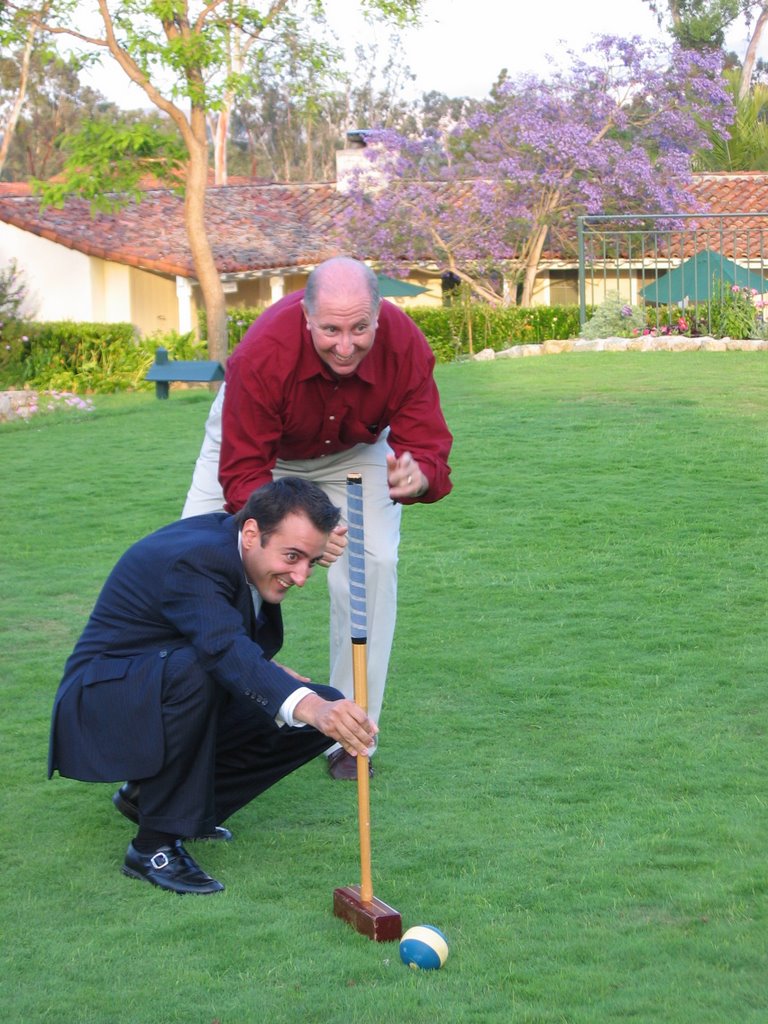
Out here in California's Central Valley, we have a pretty good kinship among the "three Bees" and the Merced Sun-Star. As if to illustrate the point, Modesto Bee Editor Mark Vasché at left helps Sun-Star Editor Joe Kieta line up a shot during a croquet match at a California Society of Newspaper Editors meeting. We're glad that the San Luis Obispo Tribune has joined the fraternity in California, and we welcome all the other newcomers to the McClatchy clan.

Saturday, July 08, 2006

Editor uses phrase 'value proposition'

Well, I can't believe it, but I actually did use the term "value proposition" in my little essay for Poynter about the future of news. And then they put it in the headline, no less.

Well, I apologize. In my defense, the essay was written in about an hour (they assigned us all that task at the conclusion of a recent seminar; other essays from that session – David Zeeck, Byron Calame, Wes Turner, Peter Bathia and more – are available here). And I did put the phrase in quotation marks, which kind of shows that I knew better.

But I wrote it, no denying that. I can only image the reaction I would have inspired from Jim McClatchy, who famously objected to anybody calling a newspaper a "product."

Nonetheless, I believe everything I said. You'll undoubtedly be hearing me same this and similar things again and again. I think it's important.
– Howard Weaver

Sunday, July 02, 2006


Thinking about Washington

I didn't do any kind of comprehensive survey, but cruising through your websites last week indicated that our Washington bureau integration and assumption of the former KRT duties have worked pretty well.

Tom Lasseter from Iraq was on the front of Mod Bee (and doubtless many others) on Sunday. Anchorage and Sacramento both used the China-Tibet railroad on A-1. Our Gitmo mainbar was the lead in Minneapolis and Miami. Lesley Clark's regional on offshore drilling was splashed across the top of A-1 in Bradenton and a David Whitney piece on drilling in California was the local lead in the Tribune in SLO. Henderson's SCOTUS overview was on the front in Macon. Mark Vasche's column and the lead edit in the Centre Daily Times Sunday both talked about improvements in Washington and foreign coverage and how excited they are about the new bureau.

Our Washington operation will be the focus of a great deal of attention in coming weeks. In some ways, it's the most visible, highest profile illustration of how the entire McClatchy/KRI integration is working. Our judgments about journalism will be noted, and no doubt critiqued. People will be watching especially closely to the jobs we fill, the assignments we change, and whatever else may come.

And, of course, there's a pretty tough bunch of critics here in the family. Our overarching objective for Washington is that it make your news products better: in print and online, wholesale and retail, at home and abroad. You're the customers who matter most.

If the bureau and MCT are delivering what you want and need, for God's sake use them. And if they're not, tell David, John and Jane what your concerns are. Maybe what you're after is a key we can use to make everything better; maybe you're wrong and we need to start that discussion instead. In either case, we won't know until we start the conversation.

And as Casey Stengel used to say, include me in. We're spending a great deal of money and energy to get this right. It's my job to make sure we do.
– Howard Weaver

Thursday, June 29, 2006

Getting to know you

In California, the three Bees have long referred to one another as "cousins," as in "I wonder if one of the cousins is going to cover this?" It's always seemed like a useful, friendly construct to me.

Well, we've all got a lot more cousins now. I thought it might be fun to share a few images here to help us identify with and understand one another better.

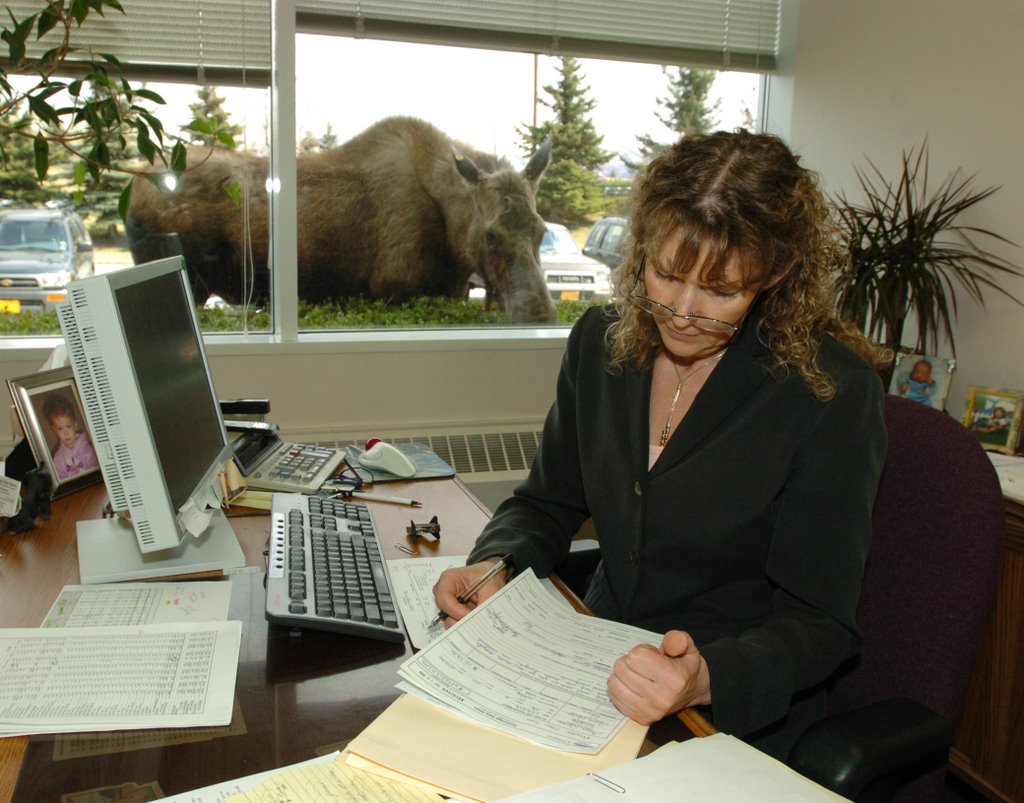
Pictured here is a woman working in the finance office at the Anchorage Daily News, a place where I worked more or less from high school until middle-age. This was taken a month or so ago, I am told. Moose are common visitors there, although more likely in winter, when deep snow in the mountains forces them to look for something to eat in your rose garden.

You have anything to share?
– Howard Weaver

Wednesday, June 28, 2006

New media isn't new any more

There is a short post here that makes a point that has seemed more and more important to me lately: we need to stop thinking about "print media" and "new media" and all such other constructs and start acting like it's all just media.

The commentator at techdirt (I have no idea what that is) put it this way:
These companies don't need Chief Digital Officers. It's not a separate job function. They need to get the entire company thinking digitally and understanding how it impacts their business.
I had the same thought recently in making a presentation to a strategic planning session at Sac Bee. I had a job here 11 years agoi called "assistant to the president for new media strategies." Dumb title, I realize, but at least it was accurate then. The digital stuff really was new media then. It's not new any more.

I had the same thought again yesterday when Kit Seelye from NYT was here interviewing some of us for her ticktock on the deal. It's so clear to me now that our whole strategy is easily ecapsulated in the simple objective: "be the leading local media company."

In our case, news media, since we aren't [yet] aiming at Disney or Sony. But when it comes to news, we want to master all media, to be fully engaged and present in instant-cycle 24/7 breaking news (online, email alerts, RSS, etc); in comprehensive printed daily briefing/orientation in the mainsheet newspaper; in video and podcasting selectively; in foreign language and other niche publications.

It's all just media. And you are in the media business.
– Howard Weaver

Monday, June 19, 2006


What happens to KRT?

The day McClatchy's acquisition of Knight Ridder closes (likely to be June 27, if all goes according to plan), KR's half-interest in Knight Ridder Tribune Information Services also changes hands. We will become 50-50 partners with Tribune in the enterprise.

The name will change. For the time being, at least, all we are doing is substituting our name for Knight Ridder's, as in the logo above. In the same way that KRT was known by its three initials, we plan to brand this MCT. (We thought about simply MT, but that has problems. Say it aloud a couple of time: Em-Tee, Em-Tee. We also thought that McT -- Mac-Tee -- sounded too much like a fast food product.) The logos and website designs will be tuned to look like the KRT trademarks to help ensure continuity of branding and recognition.

Most importantly, the high-quality content and professional service will remain the same. Some of you know that McClatchy's contractual relations as a contributor to the New York Times News Service and Scripps-Howard News Service create some complications with regard to distribution through MCT. While we are sorting that out, we have agreed with NYTNS that the 20 former KR papers will continue to contribute through MCT, while the 12 legacy McClatchy papers will keep contributing to NYTNS and Scripps.

We have also invited most of the divested KR papers to continue contributing and receiving the wire, and I expect they will. Thus KRT clients who were accustomed to seeing Philadelphia or San José stories should continue to have them. Jane Scholz and her fine staff in DC continue as before.

Of course there will be changes. The existing McClatchy papers (who were already KRT's largest customer) will get access to more of the service; somebody from the service will be contacting them about that. Distribution will change in the Twin Cities. We will have to work through which channels handle contributions from bureau staffers.

If you spot or foresee problems or anomalies, please flag them for me, Jane or David Westphal. Thanks.

– Howard Weaver

Thursday, June 15, 2006

Untitled

Does blogging make reporters better?

That's one question asked in an interview with Tacoma's award-winning sportsblogger Mike Sando over at the Online Journalism Review. (One question we can answer authoritatively is that great reporters can make great bloggers. Mike proves it.)

You can find the article on Sando's Seahawks blog here.

– Howard Weaver

Washington Post columnist Matt Cohen has written a column about the value of news vs. the value of newspaper companies to Wall Street.

I think he's right on target when he states, "... while (Morgan Stanley's Hassan Elmasry) mentions benefit to 'shareholders,' he says nothing about readers or, if you will, the public in general. 'Intrinsic value,' after all, should not always be measured in monetary terms."

I am starting to feel like Howard Beale in Network: "I'm mad as hell, and I'm not going to take this anymore!"

All industries undergo change. The strong survive; the rest are relegated to history books. Our industry is changing in many ways, but our core values are no different - or they shouldn't be, regardless of what Wall Street says. It is insane to me that an industry that regularly manages profit margins of 10%, 20%, 30% - even 40%! - gets trashed by "analysts." How many other industries in the world's richest nations wouldn't kill for profit margins of 10%? The world is upside down. Granted, I'm in a midsized market and have watched the nightmares of San Francisco's circ declines from a distance. But I think there are a whole lot of newspaper folks across the country who are reading the industry's obituary and scratching their heads, wondering how it could possibly apply to their situations.

I was watching a favorite movie the other night, Apollo 13, and one sequence in particular made me think of our industry: A couple of pencil-pushing geeks are worried the astronauts will die and say, "This could be the worst disaster NASA has ever faced." The character played by Ed Harris turns to them with full confidence and says, "With all due respect, sir, I believe this is going to be our finest hour."

-- Andy Perdue

Tuesday, June 13, 2006

Better than investigative reporting?

Hunting down bad guys and exposing corruption will always be a central mission for journalists. But will it always be the most important one? Is it now?

Matt Thompson argues in "The Press' New Paradigm" that helping people grasp the meaning of the complex information that defines contemporary life may be the highest calling for journalists these days. In an age when Enron's misdeeds went unchallenged because they were buried in complexity few could penetrate, he may have a point. I read a book not long ago called "Data Smog" that makes the telling point that bad information -- like polluted air -- can be toxic.

I encourage you to click through to Matt's essay and then come back for some discussion in the comments here. These are important questions.

But data modeling instead of gumshoes? Man, talk about revenge of the nerds.

– Howard Weaver

Friday, June 09, 2006

Quote of the day ...

Stolen from a New Yorker cartoon and overheard at a CSNE workshop called "Newsroom Reformation":

"Okay, I'm ready to innovate. What are the guidelines?"

– Howard Weaver

Clear choices in an uncertain time

I gave a short talk and answered questions this morning at the California Society of Newspaper Editors gathering in Santa Barbara, where I was asked to address both the McClatchy/Knight Ridder deal and the future of newspapers.

Attendance was lighter than usual (isn't that true at all newspaper meetings nowadays?) but there was a good representation from papers large and small throughout the state. I was happy to see Sandra Duerr and Tad Weber from San Luis Obispo amongst some familiar faces from Modesto, Sacramento and elsewhere. I was able to take in an excellent presentation on how California newspapers are using video online, including some impressive samples from small, rural papers.

I doubt there's much in my remarks you don't know or haven't heard, but what the heck; I already wrote this, so I'm going to post it here:

Remarks for CSNE Convention * 9 June 2006
Howard Weaver * Santa Barbara, CA


Some of you have already heard the story of how McClatchy’s involvement with the Knight Ridder acquisition began. We can date it almost to the moment, starting at lunchtime on November first, 2005 – a warm day in Sacramento with a small group of McClatchy executives sitting at a sidewalk table having lunch. At some point in the proceedings, CFO Pat Talamantes glanced down at his Blackberry and then stood up to leave. He read us the email from Gary Pruitt: “Knight Ridder in play. Let the games begin.”

The prospective end of Knight Ridder’s long and storied history and the beginning of McClatchy’s new adventure are not, of course, all “games.” But there is no denying that a thrill of excitement infused our discussions that afternoon, and animated the long days of hard work between that afternoon and this morning.

I heard Gary Pruitt tell Tony Ridder and his executive team in San Jose one afternoon that McClatchy’s first choice would be that Knight Ridder not be forced to sell. We believe in independent newspaper companies, and like everybody in our industry, we knew and admired what those newspapers have accomplished over many decades. It’s never a good thing for a great newspaper company to go away.

But I also heard Gary say and know that we all strongly believed that if the company was to be sold, we wanted very much to be in the hunt.

You probably know that McClatchy’s acquisition strategy has always been tightly focused and very disciplined. We look at practically every opportunity that comes into play, but we act on almost none. We had purchased the Raleigh News & Observer in 1995, the Minneapolis Star Tribune in 1998, and the Merced Sun-Star in 2004. In between were long, patient periods of saying no, of passing on one opportunity after another. We were a successful company as we were, and knew we didn’t have to grow to prosper.

But now, with the Knight Ridder sale, we were looking at the prospect of not one or two or even a half-dozen possibilities: there might be 15 or 20 opportunities here that matched our market-centered acquisition criteria. We started studying them with real excitement.

Much has been written about our decision to keep some of the Knight Ridder papers, and to sell others. I know it surprised and even shocked many in our industry, but it really shouldn’t have. McClatchy has always said that it had a strict acquisition criteria, and would apply it with discipline. So when the time came and we applied our strict criteria in a disciplined way, it really should have come as no surprise.

People typically write that McClatchy is interested only in growth markets, and while it is true in a broad sense that growth is key, that certainly doesn’t fully describe our process. If it did, anybody could duplicate it: just call up the Census Bureau, get the numbers and start writing checks.

We’ve said a number of times that the analysis actually involves a wide range of factors: household growth, retail sales, education, propensity to read and many others. We don’t describe it in detail because it’s proprietary information. I’d argue that we have been pretty successful in our acquisitions to date, and this formula is, in a way, our Secret Sauce.

What took some of the observers by surprise, I suspect, is that we analyzed Knight Ridder not as a single monolithic entity, but market by market. We ran hundreds, perhaps thousands of econometric models predicting what would happen under the broadest range of conditions: what if there was another recession? Would this roster of markets still generate the cash flow to pay the debt? What if there was a terrorist attack, or an influenza pandemic. I heard Gary say once that we had modeled everything this side of a direct hit by an asteroid.

In the end, we were thrilled to find 20 of Knight Ridder’s markets matched our criteria nearly perfectly. But the other 12 did not, and most of the stock analysts and investment bankers who got quoted assumed we wouldn’t be willing to buy and immediately sell them on account of what they call “tax leakage.” As Gary’s pointed out, we just call that “paying our taxes,” and we were willing to do so as a part of our larger plan for doing the deal.

As I have told folks in Philadelphia and San Jose, we clearly were not selecting a journalistic all-star team; if we were, those papers surely would have been included. What we did instead was pick the markets where we thought our established, tested strategy would work. It’s what we know how to do, what defines our company. Other companies have other strategies and operating styles; they are not necessarily better or worse, they are different.

We know, like all of you, that the economics of the news business are changing, and that the margin for making mistakes has become much smaller. Where dominant daily newspapers used to be something very much like a license to print money, there are now distinguished, big-city papers losing lots of money.

Equally threatening is the fact that our relationship with our readers is changing. Our credibility is under assault on all sides – from talk radio, and bloggers, from political parties and the government of the United States. Partisan advocacy and ideology – the Journalism of Affirmation – threatens to take the place of our longstanding ambition: a journalism of verification, based on fair, honest, fearless newsgathering and truthtelling.

In other words, the stakes are very high. In seeking the create a 21st century news company – one that serves diverse audiences on many platforms, when and how they want to access us – we needed nothing less than the strongest team we could field.

Today we are earnestly and diligently engaged in just that pursuit: in Modesto and Merced, in Raleigh and Rock Hill. Soon, we hope, our team will be joined by colleagues in San Luis Obispo and Miami and State College, PA.

We know the battle is not ours alone; newspapers across the country are awakening from their slumber to embrace the opportunities and challenges we have described. More and more editors have rallied to the battle cry of ASNE President David Zeeck, who said: “I'm not spending another minute of my life worrying about the future of newspapers … I believe in newspapers and I believe they will last. But I also believe in the web. Heck I'm willing to believe in iPods and cell phones. Really what I'm saying is I believe in journalism.”

And if newspapers don’t defend journalism, who will? We know no other media have the will or the wherewithal to advance our central values into the new media landscape. In each of your communities, you should have the largest news staff, the leading website, the most ad salesmen and the best reputation. We still making good money, and have resources to invest.

I cannot guarantee you success, though in my heart I truly do expect us to prevail. But I can offer you the satisfaction of a choice well made.

For what are the choices for an honest journalist today? I can think of three.

We can give up.

We can hunker down and try to bleed as slowly as possible.

Or we can fight back.

I have not one moment’s doubt about those choices.

– Howard Weaver

Monday, June 05, 2006

New press, new look in Kansas City

Today's a big day for the Kansas City Star. The full-dress version of their redesign hit the streets this morning.

As you probably know, this coincides with operations at the new state-of-the-art pronting facility you see pictured at the top of the page to the right. The handsome, downtown facility is gorgeous, modern and oh-so functional, providing both visual and financial proof of their faith in the role printed newspapers will continue to play.

At the same time, of course, the Star is at the fore in finding other channels for delivering information audiences need, including frequent video coverage at kansascity.com.

– Howard Weaver

Sunday, June 04, 2006

Could less competition be better?

Amy Graham has a post over at Poynter that dares to suggest there might be something to the agrument that competition isn't always the best thing for media.

At first blush the argument is anathema to those of us weaned on the ethic and exhilaration of completive newsrooms. I know for certain that the desire to kick the ass of whoever was covering my beat for the rival Anchorage Times motivated me more often than any deep, selfless desire to serve the public good. It kept me at the desk and on the phone late, steeled my nerves to knock on strange doors, made me double and triple check the factoids.

But Amy and others whose arguments she incorporates make some telling points. Could it be that times and circumstances have changed so much that we need to rethink the truism?

In an age of blogs and 24-hour cable and instantaneous updates on dozens of media websites, does it make sense for everybody to staff the daily White House briefing? How important is it for journalists from half our papers to staff the Super Bowl? Is your art director’s take on the Oscar preview page really that much better than the half-dozen others you could use from somebody else?

Suppose you could take the resources you’d save by skipping all that and devote them to something unique, particular and compelling? An investigation into college recruiting in your town, rather than game stories from every road trip of the Anytown Warriors; a unique graphic explanation of a controversial area shopping mall proposal, rather than that generic Oscar page; a close look at Pentagon procurement practices by Congressional district instead of a story that matches what the NYT, LAT, AP and Reuters all had from the briefing?

As we start to integrate 32 papers into the new McClatchy, these questions will become more sharply framed. Think about what you could do to optimize the resources in your newsroom by using something produced by a cousin. Think about what you can contribute to help them.

I don’t think there’s a one-size-fits-all answer here. But I am betting we will find more and more occasions where these questions matter.
– Howard Weaver

Wednesday, May 31, 2006

New thinking about news

Tim Porter has a posting over at First Draft describing what he sees as a significant shift in thinking about change at newspapers. He focuses chiefly on a recent column by Chris Peck at the Commercial Appeal, which was I suspect partly the product of some time a bunch of us spent at Poynter on the subject earlier last week.

Short version of Tim's conclusion: "The patient has swallowed the bitter pill."

After two days of talking about the future of news with stockbrokers, publishers, academics and others, Gregory Favre asked all of us to spend an hour writing something about our vision of the future, along with a short-term and long-term action item each of us could undertake to accomplish this. These are to be published on the Poynter site sometime soon.

I know I had a bit of a headstart since this is something I think and talk about all the time with you folks. You will likely recognize much of what I had to say:

Future of News
Poynter Institute 23 May 2006

A former newspaper editor named Mark Twain once famously observed that he wasn’t worried about his ability to find work because, “I figure even the people in the north of hell will be curious about what the people in South Hell have been up to.”

On that essential truth rests all my thinking about “the future of news.” Tomorrow’s appetite for real news and information will not be less than today’s. People’s curiosity will not diminish. Those who have reliable and timely information will continue to be advantaged over those who do not. And that means people who can supply such information will remain essential.

Yes, information is becoming freely and ubiquitously available, delivered around the clock and in many formats. Yet people don’t need more data in their lives. A recent book called “Data Smog” makes the point that too much information – or bad quality information – can, like polluted air, become toxic. People will always need help sorting, verifying and organizing the bewildering range of data flowing all around them, and so organizations that can do that will, like Mark Twain, always have job security.

Fortunately, those are skills that newspapers and newspaper journalists have honed carefully over many decades. While we’ve often been hidebound and stubborn about our delivery mechanisms and our relationship with readers, our much-vaunted “core competencies” are right at the center of filling this need.

The 21st century news company will have to be able to make a pitch to audiences something like this:

Yes, we know you’re awash in data and information. You wake up to NPR, listen to talk radio on your commute, surf the web when you should be working and see CNN in the lunchroom. You’ve been titillated by blogs and email alerts all day; friends and coworkers have sent you IMs about the latest item to tickle their fancy. You’ve got books and podcasts cued oup on your iPod. So what can we possibly do for you?

How about this: I’ll ask a hundred of the smartest people I know to spend all day sorting through that information, figuring out which of the blog items you saw is accurate enough to deserve your attention, comparing what the Secretary of Defense said on TV with what he told you last month, figuring what’s likely to happen tomorrow on that big story that dominated CNN. They’ll organize it in concise and manageable dimensions, collect it all in one spot and deliver it to your doorstep first thing in the morning to help you organize and orient your coming day.

In the meantime, we’ll use all those other channels as well to keep you posted on what we learn about the latest developments, and to deliver the information – chiefly local – that we alone have bothered to check out and discover.

In short, we’ll promise to make their lives better – to give them advantages over less well informed or less carefully briefed colleagues and competitors. We can help them narrow their choices for entertainment or understand why the local coach was so stupid. We can share an emotional connection with neighbors, or expose a corrupt contract at city hall.

That’s a hell of a “value proposition,” a promise to deliver real benefits in exchange for their most precious possession: a piece of their busy day. In the coming “attention economy,” where the only thing in short supply is time, that’s the only way to be valuable to people.

I haven’t spent time talking about the economics of the industry here partly because it’s not my expertise, but also because I have considerable confidence in the resilience of our basic business model: selling audiences to advertisers. If we assemble quality audiences and learn to deliver them (or partner with people who can), there will be willing buyers for that service. I can’t promise a smooth transition from our quasi-monopoly position to this new reality, but my faith in it is undiminished. (Basically, I trust that smart colleagues on the other side of the house will work as hard and intelligently on the business model as we are on content.)

In the short run, I can help secure this future for our industry by helping people get over their fear and frustration and embrace the opportunities. Al Gore says the biggest challenge in getting people to deal with climate change is that they tend to go straight from denial to despair when they contemplate the future. That seems true for people in the news business, as well. Fortunately, that cloud of gloom is easily dissipated by clear thinking and refocused perspective.

In my view, the long term is less frightening and less perplexing than this interim, transition period in which we must continue our traditional operations while embracing change. (Insert metaphor here about changing the oil in your car while driving down the freeway ...) But perhaps our best service in this will be to help our colleagues recognize that these aren’t really two separate tasks so much as a migration from one form of storytelling to another – a relocation, perhaps, from the north of Hell to the south, or even to happier climes.

– Howard Weaver

Friday, May 26, 2006


James Briggs McClatchy
1920–2006

Excerpted from comments at
McClatchy Editors & Publishers Meeting
Fresno Bee photos
September 17,1993
Squaw Valley, California

by James McClatchy

Turning to the matter of newspaper character, the philosophical basis on which a newspaper rests is extremely important. Why is it published? Only to turn a profit? Or does it have another purpose? Is that purpose clear? Or is the character of the paper muddy?

Do our newspapers have something other papers don't have? Are we really different? The answer is yes, our newspapers have philosophical roots.

What has been this unique character? For one, a caring about the way things are for the ordinary person, caring about the way the world is, the way the state is, the way the city is. An intensity of concern, almost a personal expression of concern. This may be individualistic or even eccentric, a reflection of our origins and the personalities that shaped the Bees, a still-living connection to the issues and challenges and problems that existed 135 years ago and still exist today.

That concern was personal and expressed by editors 100 years ago, and 50 years ago, and it should be strong and expressed by editors 50 years from now.

I say it is not enough for us to have integrity and independence. We have those qualities and we are rightfully pleased with that, but every newspaper is supposed to have integrity and independence. That isn't enough.

The first Bee was founded by men who had a cause, who fervently believed in a just society. The newspaper they created showed it. It was passionate and aggressive about a lot of issues but it also was sensitive about individuals. It cared about the things that would make this new community a just society-affordable bank interest rates, land for settlers, an honest court system, cheap electricity when it arrived and clean water, trees and parks, good schools and fair treatment for the ordinary man.

The owners and staff have made major contributions to the fabric and quality of community life by working to get all these things. The Bee had policies that expressed their personal commitment to these practical goals as well as important philosophical values.

It is terribly important that these values and views and ideas and traditions, some of which are odd or idiosyncratic, be kept alive and respected. We need to be true to what we have inherited. We need to preserve the values from the past that give us strength today.

That won't happen without conscious effort, and the editorial committee is one of the tools to accomplish it.

If I believe in anything, I believe we must keep the faith with the many people who gave these papers not only integrity and independence, but extra elements of character and personality and convictions. These elements enriched their communities and made positive contributions towards that ideal of a just society.

Obituaries:
The Sacramento Bee
Sacramento Bee editorial
New York Times
Associated Press (via Mercury News)
McClatchy Company press release
– Posted by Howard Weaver

Saturday, May 20, 2006

Sign your post, please

Just a reminder that since we're using my old blog as a joint effort, you need to append your name to your post so we can tell who says what. When you add a comment, the software identifies you automatically. But since it only expects on blog owner, main posts show up without ID.

(The item about Miami below is from Fitz McAden in Hilton Head, I believe).

– Howard Weaver

Thursday, May 18, 2006

Valedictory or benediction?

In recently rereading two good speechs from ASNE, I was struck by the contrasting message I carried away from each.

The first was John Carroll’s fine speech to the assembled editors, entitled “Last Call at the ASNE Saloon.” It is a characteristically well-crafted work of art, but it is at its core more valedictory hymn than blueprint for solutions.

The writing is elegiac, the focus nostalgic.
“The golden age is over,” he tells us. “With the advent of the web, our rotary presses, those massive machines that once conferred near-monopolies on their owners, are looking more and more like the last steam engine … Then there’s a more subtle problem, a crisis of the soul.”
Well, not really, John.

Contrast his message with that of our colleague Dave Zeeck (who is, I feel certain, as big a John Carroll fan as I):

“I'm not spending another minute of my life worrying about the future of newspapers … I believe in newspapers and I believe they will last. But I also believe in the web. Heck I'm willing to believe in iPods and cell phones. Really what I'm saying is I believe in journalism. I believe in the future of news … What we do isn't about the ink and the pulp, though my love for both endures. It's about journalism. Turning over the rock. Finding the story. Telling it in a compelling way. Changing a life. Opening a mind. Righting a wrong. Making a community better.”
I’m not trying to set up a Zeeck-Carroll steel cage death match here. There is much to learn from each speech, and much in common between then. You can find a pdf version of Carroll’s remarks here, and David’s speech is available here.

But here’s one thought that certainly occurs to me as I read them: the epic, big-picture pirouette may not serve us very well as we go about the daily business of telling our communities what they need to know. Neither the sweeping jeremiad – What Hath God Wrought? – nor the revolutionary manifesto – Blow up the newsroom! – offers much real guidance for doing what we must do.

Dave offered an historical reference, from the Hebrew Book of Ethics, in summary:

The work is great
The day is short
It is not our duty to complete the work
But neither are we free to desits from it.


I’d add that Abe Lincoln had some advice about navigating a considerably more epic struggle back in his day. Speaking of the unimaginable issues facing a country at war with itself, he observed, “We must disenthrall ourselves, and then we will save our nation.”

Let’s make it so.
– Howard Weaver

Wednesday, May 17, 2006

Dave Zeeck's leadership

Tim Porter, a former newspaper journalist, digital advocate and frequent critic of how print media have approached the future, has some enthusiastic words of praise for Dave Zeeck's ASNE speech in Seattle a couple of weeks ago. You can read his take on it here. You can read Dave's entire speech at the News Tribune site here.

Tuesday, May 16, 2006

Regardless of what you think of Dallas Mavericks owner Mark Cuban, you gotta love his latest blog post:

Where Newspapers kick the Internets behind

Here's a really, really rich guy who gets home from a playoff basketball game and wants more info, so he surfs the Web looking for more info. Can't find it at Yahoo! Sports. Not happy with ESPN.com. Finally goes to bed. Gets up and reads the Dallas Morning News and the Fort Worth Star-Telegram. Now he's happy because he's getting more original content from ink on paper than from various Internet sources.

Mark Cuban is not unlike a lot of sports fans (except for his millions). Frankly, he's a lot like political junkies and other news addicts. Providing original, compelling content is what separates newspapers from other information sources.

-- Andy Perdue, Tri-City Herald

Monday, May 01, 2006

Coverage from ASNE

Here's a taste of the coverage and commentary from ASNE last week. If you know other good pieces, please link them here or in the comments:

David Zeeck, in The News Tribune
Deborah Howell in the Washington Post
David Shribman, Pittsburgh Post-Gazette
Ryan Blethen, Seattle Times
Al Neutharth, USA Today
– Howard Weaver

Saturday, April 29, 2006

Are you ready for the 'newspaper i-Pod?'

The final speaker at ASNE convention in Seattle this year was a local celebrity: Microsoft boss Bill Gates. Much to my surprise, he had something important to say specifically to newspaper editors.

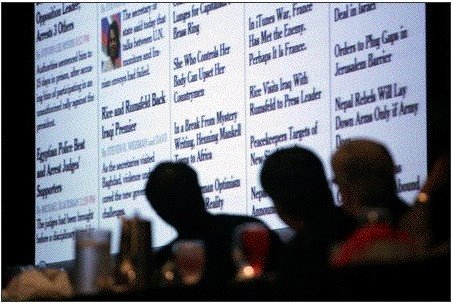
Gates used the occasion to introduce software that will debut as a built-in feature of the new Microsoft Vista OS in January called Windows Presentation Format (WPF) . It's essentially a toolkit that allows programmers to build online/offline software that will display publications (or, I suppose, anything) in tailored formats that can closely resemble printed text, right down to the fonts. (This AP photo shows the demo at the convention.) Users navigate by "turning pages" rather than scrolling, make notes in the electronic margin, search, clip and email selections. Publications will be downloaded to users' drives and thus can be read without a live internet connection and refreshed whenever users are online. It's not a PDF or web archive. It's much richer.

The Vista OS is due in January, and Gates said developers kits for working in WPF will be available by late summer. The NYT got an early copy and has its version – called TimesReader – in workable form now.

The Seattle P-I had a story about the demo, as did the Seattle Times, here and E&P, here.

Perhaps most impressive to me was the testimonial of Tom Bodkin, design director and AME at the New York Times, who said he'd be working on their prototype implementation and has become "a total convert." Particularly when used on a handheld, tablet-device of some kind, the experience of reading in this format is nearly as good as text on paper -- and has many advantages once-a-day printed publications can't touch. Some of the advantages are obvious – text can be updated and changed constantly, whenever the reader in online – and some less so. For instance, clicking on an ad can bring up a richly animated video-style commercial. Probably it could easily open to full video, as well. WPF also incorporates the capacity to sense what size screen you are using and adjust the display to take fullest advantage of it. In the demo, anyhow, it was impressive.

I talked to Bodkin briefly afterward and met the "product manager" for TimesReader, who promised to get in touch. When I find out more I will post it here.

Both Gates and Bodkin talked about how holding the tablet or reader in your hands made reading "natural and effortless" in a way no fixed screen can match. (Readers typically make constant, microadjustments to the book or page they are holding to read, shifting the distance or angle to get it just right. This apparently comes close to that.)

Would a well-crafted, handheld tablet displaying newspaper copy in this new format have the capacity to become the "newspaper iPod" some have dreamed of? Here's hoping.
– Howard Weaver

Saturday, April 22, 2006

Tough times, bright prospects

Let’s say this straight out: these are tough times at newspapers.

Start with the uncertainty and anxiety of being in a phase transition for the news business. Not knowing what the future holds or whether it will continue to value what we do is scary. We make decisions every day about a future we cannot know. We go to sleep every night less certain about tomorrow than at any time in the last 30 years.

And at the moment, we must do so in an operating environment of slow ad sales and stalled revenues. I’m convinced this is mainly a cyclical (and temporary) downturn like those that have always punctuated the newspaper business – not the leading edge of some inescapable secular change that's beyond our reach or response. Nonetheless, it sucks, and we have to manage through it – often by reducing expenses, tightening belts and curtailing spending.

Add to all this the new X-factor in our world at McClatchy: the increased scrutiny that comes with our bid for Knight Ridder, and the vastly higher stakes for which we’re playing. This, we have already learned, multiplies all the normal pressures and intensifies concern about our performance. We don’t run McClatchy with a short-term perspective – but performance has short-term consequences nonetheless, and there’s no denying that we have felt some already.

These pressures feel especially frustrating right now because they come at a time of extraordinary opportunity and promise. In my gut I know we are on the threshold of far better times – an environment where we have mastered new platforms and technologies to extend our reach, where citizens recognize the value our “journalism of verification” brings, where that all adds up to revenues that comfortably support us.

I also know the colleagues who will shortly join us from those 20 Knight Ridder newspapers and their Washington bureau will make us stronger, better and more productive. Together we’ll create a leading 21st century news company, and in doing so prove that real journalism is central to any media landscape that may emerge. We will find better ways to multiply our strengths online and with the wire service and through other alternative deliveries. We’ll get better at knitting all that together. We will forge closer, more trusting relations with audiences – real people, not partisans and advocates – and their support will sustain us as we serve them.

I have more confidence in our future today than I did 10 years ago. There’s proof-of-concept all around us, and our efforts to extend those winning ideas throughout the company are accelerating.

Some of this is very hard, but we can navigate through without blunting the forward progress. There’s some house-to-house fighting through the budgets yet to be done, but it comes with the promise of transformation on the other side.
– Howard Weaver
Powerful video-online-print collaboration at TCH

Here's a lesson in interactivity and web-print cross-promotion from the advertising side of the house: a fun and successful initiative from the Tri-City Herald that supports the paper's yard sale advertising effort as it kicks off for summer.

It starts with an interactive yard sale map where you can search by location in a listing, by clicking on a map or doing a refined search in a database. (Caution: it didn't work on my Mac with the Safari browser, but Firefox works fine.)

To help promote the effort, the TCH team picks an advertised yard sale at random each week to get a suprise visit from the Tri-City Herald Yard Sale Team,which delivers free coffee, donuts and balloons and searchs the sale for the best bargain a dollar can buy. This is all videotaped and delivered in an online "Yardcast," which is a lot of fun. You can see one here.

The team also produces a weekly video with tips and tricks supplied by veteran area yard salers who tell you how to make your sale more successful. An example is linked from the same Yardcast page, available here.

This is a powerful build on the TCH's long strong of video successes, anchored of course by their powerhouse high school football videos -- which can draw more viewers during football season than all three local television sportscasts combined.

The Herald does all this with a small but creative and dedicated staff. Have a look at the quality they're achiving with modest hardware expense and talent all drawn from exisiting staff.

Doesn't it make you think there's more you could do with your staff?
– Howard Weaver

Sunday, April 16, 2006

Q&A with the NYT

Bill Keller answers questions from readers and others in a online chat that the Times says will become a regular feature. It plows a lot of ground that will familiar to those of us who read Romenesko, the trade press and one another's newspapers. Nonetheless, there are many nuggets, some of which I've appeneded here. The whole piece is available by clicking here.

Keller: Not long ago a colleague at the Boston Globe convened an informal committee and tried to list the standards that we aspire to. Here's what she came up with:

  • We believe in a journalism of verification rather than assertion, meaning we put a higher premium on accuracy than on speed or sensation. When we report information, we look hard to see if it stands up to scrutiny.
  • We believe in transparency -- that is, we aim to tell you how we know what we know, to attribute our information as much as possible to named sources, to rely on documentary evidence when we can. As your math teacher might have said, we "show our work."
  • We are agnostic as to where a story may lead; we do not go into a story with an agenda or a pre-conceived notion. We do not manipulate or hide facts to advance an agenda. We strive to preserve our independence from political and economic interests. We do not work in the service of a party, or an industry, or even a country. When there are competing views of a situation, we aim to reflect them as clearly and fairly as we can.
  • We don’t do this as a hobby but as a living. Whether you call it a craft, or a profession, or an occupation, it is something we take seriously, and we demand levels of training and experience that we seek to pass on from one generation to the next.

Q. The colorful lead is the bane (or at least one of the banes) of my time spent with The Times. So often, I have tried quickly to get the gist of a story (this happens in the Sports section more often than in the news sections) only to find that I must read something like "it was a dark and dreary night" before finding the point, or the score, or even a notion of what the article is about.

Whatever happened to the inviolate rule that a lead was 35 words or fewer, telling us where, why, what or who?

-- Peter C. Boulay, Bronx, N.Y.

A. As the sun blazed above the snow-lacquered peaks of the Hindu Kush, the weary editor flipped down his clip-on sunglasses and booted up his laptop.

It had been a long week, a soul-sapping, disorienting and yet strangely satisfying week.

Past the simple campsite where he awaited his digital connection to the modern world flowed all the human mystery of the East: the women shrouded in burqas of azure, or possibly cerulean, he was not too good on blues; the camel-borne warlords draped with belts of bullets; the shoeless boys in filthy "I Heart New York" T-shirts; and all the rest, all separated by semicolons and swaddled in colorful cliches.

The computer flickered to life. The keys clicked like castanets until up came a complaint from the northern part of a far-off metropolis at the eastern end of a troubled superpower. The editor read. He frowned. Then he squinted down at the keyboard and typed:

"Amen, Mr. Boulay. Amen."

–Howard Weaver

Saturday, April 15, 2006

An advocate for urgency

(This post first appeared as a comment to an earlier observation below.
It was promoted to this location to make sure everybody sees it).


Good criticism. I certainly don't try to be driving people to jump off cliffs. I'll keep that in mind next time I hit the alarm button. But then again, I do think that the industry has lacked a sense of urgency and that if they do not embrace rather than resist change, then they will be left behind. And I would regret that. So is it equally a disservice to be too comforting, to give the impression that there is time to bide on these issues? I'm a journalist, a newspaperman, and next a journnalism professor. Clearly, I value the craft. But I do believe that if the craft does not update itself, it is in danger. If I'm too loud or strident on that -- and I know that I certainly can be -- then I take the criticism.
– Jeff Jarvis

Wednesday, April 12, 2006


Q: How many kids with ADD does it take to screw in a light bulb?
A: Hey! Let's go ride bikes!


Even when I'm squeezed for time, I usually read two small magazines: New Scientist, and The Week. I'm more likely to spend time with them than the New Yorker (which I always do enjoy when I get to it) or even the astonomy magazines that pile up by my recliner.

What those two have in common is brevity and a well-defined theme. Each is a kind of overview or survey. Immodestly enough, New Scientist bills itself as "The week's best ideas," while The Week proclaims itself "All you need to know about everything that matters." With them, I can spend a half-hour or 45 minutes and feel like I accomplished something. (I've been reading "The Rise of American Democracy" forever – it's 992 pages – and 45 minutes there doesn't feel like any progress at all.)

I think we need to help our readers feel some of that satisfaction reading the paper: the sense that you can get through it and come away satisfied, even if you don't read everything. Busy people need points of exit as well as points of entry into the paper.

What kinds of techniques can accomplish that?
– Howard Weaver
Extension & integration in Tacoma

Chris Hendricks and I spent a productive hour with executives from the Tacoma News Tribune this week reviewing progress they have made across a wide front of print/online integration and extension projects. Similar efforts are underway throughout the company in various iterations; rarely are so many moving ahead so well together. Here are some highlights from my notes:

  • Podcasts are being used to provide behind-the-scenes reports with writers and photographers. Any way we can share "how I got that story" and other informative reports with readers will help build credibility and increase transparency. Learning how much work your staffers go through to produce a detailed investigative report, or how the creative team worked to present a photo package on deadline will help demonstrate how we add value to information, a key differentiation for our news reports.
  • Although still new and limited in number, blogs have quickly established themselves as a leading draw for TNT online. (It probably doesn't hurt to have your local football team go to the Super Bowl). In addition to sports, they blog food, real estate and nightclubs. A shared editors' blog, military affairs blog and guide to local online sites are soon to come.
  • A continuous news desk, located in a refurbished pod in the middle of the newsroom, has animated live news updates for the website. Staffed starting at 6 a.m., the operation keys on weather and traffic for early drive-time reports as well as breaking news.
  • Photo galleries featuring staff work and photo submissions from readers both help attract traffic. A dozen reader/photogs were selected to help document hourly segments of a recent "Day in the Life" photo feature on the site and in the paper.

TNT continues to extend in other ways, with numerous staffers participating in radio programs, appearing in classes and at civic functions, and organizing community participation events. The paper is currently gearing up to sponsor a community forum on the topic of gay marriage, with the goal of being able to convene and host the event within 48-hours of an anticipated Washington Supreme Court ruling.

The take-away here is that sustained effort on a variety of projects is key to building momentum for change, especially in early stages. Audiences for many initiatives will be small, particularly at first, and even newsroom constituencies may be limited. But if we keep trying – reenforcing success and reengineering when we miss – we can make real progress to meeting changing audience needs.
– Howard Weaver
A human face for pandemic flu reporting

Tri-City Herald
reporters worked with interactive colleagues to produce a series of simple video introductions that auguments a recent series of prospects for pandemic flu in the paper's Mid-Columbia region. Their reports (which can be found here) sometimes presented information independent of textual reports, but more often were simply introductory. Even in those cases, however, the effort added considerably to the presentation, helping give a human face to the reporting and introduce staffers to their audience. The Herald – which was a company leader in putting high school sports video online – continues to get a big bang for a small video investment, and they keep pushing the fences.
– Howard Weaver

Sunday, April 09, 2006

An "unconference" about saving news
(and a word about Jeff Jarvis)


In addition to the pointer in the post below, Dave Zeeck writes to ask if I have seen this discussion at BuzzMachine about a Philadelphia conference on the future of news. One of the key take-aways, from Jeff Jarvis:
I say this is the day that the war ends. This isn’t journalism against bloggers anymore. It never was, really. This is journalists and bloggers together in favor of news.
And Dave also asks, "Why is Jeff Jarvis one of your least favorites?" That question provides an opportunity I'd like to take to expand on the passing reference I dropped into a post last week.

If I'd been thinking more carefully, I would have resisted that cheap crack and said something like "Jeff Jarvis is one of my least favorite press critics – for the same reasons that he is one of my favorite voices discussing the future of news." My concern arises because I think Jeff's pronouncements too often tend to be apocalyptic and consequently disheartening for many newspaper journalists. When he writes that way about our need for fundamental change, he can engender the reaction I have heard Al Gore attribute to attitudes about global warming and climate change: "People tend to go straight from denial to despair." I don't think that helps.

You know me: I'm more inclined to the teach-from-success model: Catch them doing something right. But I do recognize Jeff as an informed and articulate voice for change, and I know he's looking for the same result as most of us: a future in which the essential attributes of real news -- independence, authenticity, verification -- can be preserved and presented, in whatever form audiences demand.

Make up your own mind: for those who haven't been following it (you should), his work is over at BuzzMachine.
– Howard Weaver

Two clear, probably transforming trends

I wanted to bring an article from the latest AJR to the attention of others. It's available here.

It's about four newsrooms (Houston Chronicle, Washington Post, USA Today and a small Maryland daily) and what they're doing with the continuous newsroom. Some of us are already experiencing many of the things they're talking about, but it's an interesting reference point for all of us.

Here's a set-up graph by Carl Sessions Stepp, who wrote the piece:

Most striking are two clear, probably transforming trends: a move toward merging online and print newsrooms, and a surge toward producing news almost around the clock. These changes may well revolutionize newsrooms, and they raise important questions. Who will produce the volumes of copy required? How will quality be monitored without the overlapping layers of editing? What will be stressed in hiring? How will all this affect the enduring and ingrained newsroom culture?

– Dave Zeeck

Wednesday, April 05, 2006

Welcome, Jay

David Westphal's observations about Bill Keller and the Never Ending Argument were picked up and republished at Jay Rosen's PressThink this morning. available here in the midst of a continuing good discussion. You may want to slide over and have a look.

And this is likewise an opportune time to remind you that our blog here is indeed open, and while we don't advertise or promote it, folks can and will come by and see what you have written from time to time. (There's a comment in a post below from a "potential Charlotte colleague" that likewise underscores the point about non-staff people reading and using Etaoin Shrdlu).

This is a good thing, but do be aware that the debate isn't simply all in the family.

– Howard Weaver

Tuesday, April 04, 2006

'Craigslist meets CitySearch-like service,
behind a Google-like façade'


Despite her somewhat improbable name, Bambi Francisco has watching and writing about online media for years now and is a leading commentator on the CBS Marketwatch website. In "McClatchy's mini-Google strategy," based on conversations with our own Chris Hendricks, she takes a look at the McClatchy online effort and comes away impressed. Worth a look.
Never ending argument: it that a bad thing?

Jay Rosen, the NYU journalism prof who writes at PressThink, has a piece on the UK Guardian website wondering why the NYT's Bill Keller is so leery of transparency that he doesn't read Romenesko. In "The never ending argument," Rosen offers a fairly balanced discussion of why Keller finds blogospheric debate too self-referential and endlessly contentious to be worthwhile. Unsurprisingly, Rosen disagrees, and approvingly cites one of my least favorite press critics -- Jeff Jarvis -- joining in rebuttal.

Taken all in all, I find Keller's point of view articulate, reasonable and entirely understandable, but I think Rosen and Jarvis have the winning arguments.

I curious what it feels like to you.
Good news for newspapers online

You probably heard about studies released during NAA sessions that found good news for newspapers online: big increases in use of newspaper websites, and encouraging trends about younger people still be interested in news. The Washington Post does a decent job of summarizing both here.

Sunday, April 02, 2006

"Karma plays a role, man"

Today's NYT business section has an article about how not-for-profit media -- think craigslist or Chowhound -- are nightmares for businesses tring to make money for the same services. It's well worth a read. (The headline above is the last line in the piece).

I'd like to encourage some further thinking about this, specifically from our perspective on the news and content side of the equation. The reporting and other services we offer are valuable and will continue to be, but we're in danger of being left behind and consequently marginalized if we fail to repond to the growing bottom-up, peer-to-peer movement that animates so many of these alternative services.

There are lots of applications. I'm thinking today specifically about hyperlocal community news. And I'm thinking about ways to have your readers provide it for you (and for one another).

We need to learn how to do this. I'm sure there are many ways to approach it; here's one:

Why doesn't somebody assign a copy editor work as liason with readers who want to write about what matters to them, and then set aside a few columns or half-a-page to publish the results on a regular basis?

I'd tell the editor to worry about libel, taste and basic readability -- but not at all about subject or tone. Letting readers tell us what matters to them -- what they think is worth covering -- is at the heart of this experiment. Letting their voices show through is essential.

You could obviously run as many of these contributions as you wanted online, where space is no premium. You'd want to pick the best of them for publication. I'm certain that publishing some would encourage many more contributions, which would make for a stronger pool from which to select the next round for publication.

Properly framed, labeled and promoted, this could become an important connection with readers, talking about what mattered to them, and doing it in their own voices.

Anybody want to talk about trying this? I'm available.
 
/*