Monday, November 27, 2006

Bloated and oblivious

Here's a perspective you don't read much in your MSM publications: the view that the L.A. Times newsroom is, indeed, "bloated and chronically oblivious to the needs of its customers."

Philip Terzian is books and arts editor at The Weekly Standard, a one-time L.A. Times reporter and (on the evidence of this one column) a political conservative who's right at home in that publication; his analysis is worth your consideration independently of its modest political slant. He's named some issues that too often go unspoken in these debates, and God knows we need to be as clearheaded and agnostic as possible in searching for solutions.

Here's an observation that belongs on your radar in pondering the future:

A half-century after the death of afternoon newspapers, and one decade into the Internet, we may locate the future of daily print journalism roughly halfway between the Times and the Tribune: leaner products, appealing to older, more affluent readers, emphasizing local news but with quality national and foreign coverage, and culture and features, to prevent a wholesale exodus to the Internet.

And here's another, somewhat more acerbic sample:

... while it may be poignant to read about the editor of the Times standing up to those profit-minded meanies in Chicago, the Tribune Company is on to something. If the long-term survival of newspapers is at stake, it will not be secured by fat and happy newsrooms, or writers and editors incessantly addressing themselves to other writers and editors.
–Howard Weaver

Sunday, November 26, 2006

Why this matters

Caught up in the sturm und drang of contemporary newspaper economics, it's easy to lose sight of the bigger issues at play in our struggle.

Here's an example: the inventor of the World Wide Web is worried nowadays about the "bad things" that could emerge as misinformation and "undemocratic forces" multiple on the net.

Says Tim Berners-Lee:

If we don't have the ability to understand the web as it's now emerging, we will end up with things that are very bad … Certain undemocratic things could emerge and misinformation will start spreading over the web.


Well, no shit.

Meanwhile, elsewhere in Great Britain, a Guardian journalist writes of the despair he feels about the deepening pool of conspiracy and irrationality he encounters on the internet (and elsewhere in daily life.) In concluding that "We rationalists are the oppressed minority," he describes having posted on a website that argues Bush and Zionists were behind the 9-11 attacks:

I feel battered by the relentlessness of their insults. "I'm not going back there again. Horrible, patronising, codeword-using anti-semitic bastards," I eventually think. "They're so irrational. They sit behind their computers all day, pontificating away, getting their 'facts' from YouTube. They probably all look like Comic Book Guy from The Simpsons."

It's a peculiar post and I can't tell where the columnist is headed, but his central point is plain to any of us who has been flamed for an editor's blog entry, cursed on the phone by a pro-or-anti abortion crusader or backed into a corner at some cocktail party by a conspiracy theorist.

His solution is public assertion of rationality (apparently extending all the way to militant atheism). Mine is to cling ever-more tenaciously to the principles of journalism that have animated our profession.

We're in the verification business. What we do is so much more important than simply passing along information or factoids. Go back and reread Jack Fuller's description of "the truth discipline" in News Values. What we do isn't the same as what people do in chat rooms, or on most opinion blogs.

What we do matters. And that's why it's worth all our best efforts to keep doing it, even in hard times like these.
–Howard Weaver

(For more on the question of conspiracy in public affairs, see the post that provoked this at SacredFacts, a blog by Richard Sambrook of the BBC.)

Thursday, November 23, 2006


Somes answers from
the Strib's 'Big Question'


The Star Tribune's innovative combination of blogging and reporting (called "The Big Question") has been focused on the campaign in recent weeks. Today writer Eric Black explains how he plans to extend the feature beyond elections and campaigns.

I think Eric and editors at the Strib are onto something here. Eric serves as a hybrid journalist, factchecker, referee and guide. He explores public debate and discussion from a disinterested but never uninteresting perspective.

You might want to check in on the blog from time to time here. Here's where Eric says it's headed next:

The plan for the moment for taking the Big Question into the post-campaign future includes continuing to do “Is That a Fact?” pieces, only now they won’t be just about campaign ads, plus the new “Verbatim” feature, and one I’m calling “Are You Sure?,” a critical thinking exercise about gaps between the conventional wisdom and the evidence that should support it.

For my next trick, I’m hereby inaugurating “Do You Believe in Logic?” (yes, it is a reference to the Lovin’ Spoonful song, if you don’t get it, ask your parents). If it works, this will be an effort to scrutinize the logic, and not just the accuracy, of public discourse.

–Howard Weaver

Don't bet against
the internet


It won't surprise you to hear Google's CEO holding forth on the importance and potential of the internet. (Their stock just passed $500 a share; maybe they're onto something there).

One of his most interesting observations is about how the internet is far more than a ubiquitous delivery system; it's also making fundamental changes in how we live.

I know this is true for me. I keep reminders of things like locker combinations by sending myself Gmail, which I can then retreive and search for nearly anywhere; I have a cool Verizon EVDO modem that lets me look for the nearest Home Depot while Barb drives around in circles; I get a lot of my news from my 60-something feeds at Google Reader.

I'm not going back.

Google's Eric Schmidt, from the article (emphasis added):

But what’s surprising is that so many companies are still betting against the net, trying to solve today’s problems with yesterday’s solutions. The past few years have taught us that business models based on controlling consumers or content don’t work. Betting against the net is foolish because you’re betting against human ingenuity and creativity.

Of course this new technology raises profound challenges for many established companies. Skype, an internet telephony business (voice over IP), is as disruptive to the economics of the telecommunications industry as China has been to the global manufacturing sector. But that disruption is only going to intensify.
–Howard Weaver

Tuesday, November 21, 2006

Current TV's Pro-Am model
for user-generated content


They call it VC2 (for viewer-created content) but in fact the hundreds of video productions on Current TV can also be recognized as another form of citizen journalism. Here, as we've discussed in earlier postings, the emerging model is the "Pro-Am" construct, where volunteers supply the content, but professionals select it, shape it and ultimately determine what makes the cut. Importantly, Current goes out of its way to help viewers succeed as video producers, including extensive online tutorials.

Here's a taste of the interview at NewAssignment.net, featuring Robin Sloan:

[W]e make decisions in a spirit of collaboration, taking cues from the [viewer feedback] on the site, but acknowledging that the responsibility for a good, informative product is ultimately ours. What that often means, practically speaking, is that our amazing VC2 team will work with a producer to polish a piece before it goes on air. A lot of what you see on TV is literally a mix of organic uploads and professional polish.
–Howard Weaver
Living history in North Carolina

If you missed this link on Romenesko today, E&P reported on an ambitious joint effort over the past week by The Charlotte Observer and The News & Observer of Raleigh.

We teamed up to produce a 16-page tab section, published Friday in both papers and the Wilmington Star-News, and additional reporting on what's known as the 1898 Wilmington Race Riot, a long-buried chapter on the successful white supremacy movement in North Carolina whose champions included both our newspapers. Josephus Daniels, who bought The N&O in 1894, was one of the leading architects of the Democratic Party's campaign to seize back control from a coalition of Republicans and Populists. The 1898 story has become a current event in North Carolina because of the publication of a 500-page report by a state commission, released this year. Among the commission's recommendations: that newspapers in the state acknowledge their role. We had considered a special section before the final report came out, but the recommendation cemented the notion.

Because of the newspapers' role in this history, we hired an outside writer to do the main piece (author and historian Tim Tyson), The Observer's Eric Frazier tracked down descendants of black and white participants in the 1898 events and both papers did supplemental stories. The E&P piece focuses on the editorial page apologies that coincided with the news stories. Both The N&O and Observer, which offered the section and a one-page summary to newspapers across North Carolina, are getting numerous requests for additional copies and generally positive comments from readers. A common refrain, even from native North Carolinians: I never knew this.

To see the work on our sites, click the home page links above or go here for The N&O's "Ghosts of 1898" page.

Monday, November 20, 2006

Another view of the
future of newspapers

Michael Hirschorn has a piece in the Atlantic Monthly online exploring the future of newspapers that's worthwhile for a couple of reasons.

First, it's an intelligent and provocative take on how journalists and newspaper might adapt to changing media dynamics to turn liabilities into assets. Despite occasional moments of amusing myopia and ignorance (AP video as a "breakthrough" effort?) it's smart and well reasoned.

Secondly, it leads and concludes with references to EPIC, the futuristic mocumentary that predicts the demise of MSM at the hands of Googlezon, et al. And EPIC, as you may know, is the product of our own Matt Thompson (deputy online editor at the Strib) and Robin Sloan, who really ought to be working for McClatchy himself.
–Howard Weaver

Sunday, November 19, 2006

Is this the generation
called to save
journalism?


About 11 years ago, working on McClatchy's strategic plan for internet publishing, I left Manhattan to interview Jim Wilse in New Jersey. I got on the train in Times Square and got off in Star-Ledger Plaza. I wondered even then if there’d ever be another time when newspapers were powerful enough to etch their names thus on the civic landscape.

In Chicago Friday for a meeting with our MCT partners, I waited for an elevator in the lobby of Tribune Tower and felt an even more powerful, more foreboding question about our place in the scheme of things.

Have you seen the tower? Modeled after Rouen Cathedral in France, the Tribune’s headquarters stands as an icon for Chicago and the newspaper world. The 36-story tower grew from a 1922 competition seeking nothing less than “ the most beautiful and eye-catching building in the world.” Col. McCormick surely did not doubt that his newspaper deserved that. As if to punctuate its grand, self-confident style, the building incorporates stones from famous locations around the world – the Alamo, the Coliseum in Rome, the Great Wall of China. Apollo 15 obligingly brought back another from the moon.

And today, of course, the fate of the 159-year-old company the gothic tower houses is very much up in the air. The marketing of Tribune Company is the biggest in a continuing series of seismic events that have rattled media companies of late. Dow Jones sold six newspapers, and Copley is trying to sell seven. The New York Times sold its television stations and the Boston Globe may be in play. Belo eliminated its pension plan, Cleveland and San Jose added to the growing ranks of laid-off journalists. Akron and Contra Costa decided they could do without executive editors.

More and more, it looks like we are going to be the generation called on to save American journalism. It’s a nice honor and all, but it’s not going to be easy.

In fact, it will be brutal, as the sad litany of recent events well illustrates. McClatchy hasn’t escaped unscathed, either, and we know there’s more pain to come. Revenues continue to erode, undermining the business model our traditional operations were built on. If we make a lot less money, we’ll have to spend a lot less, too.

And that leaves fewer resources for the crucial fight at hand. “Business as usual” isn’t possible, and “journalism by attrition” – doing everything 10 percent less well than we did it yesterday – is inadequate.

How do we handle that?

Partly by reaching out on new platforms and in new channels. Partnerships are sure to play an increasingly important role. We can be even more relentless in expense savings, negotiate better rates, learn to share content more regularly. Although people are working hard and productively, we all know we can manage to a higher standard.

Most fundamentally, we need to reinvent the way we do things – where we focus the resources we have, how we manage our newsrooms. If you were starting from scratch today, would you build a newsroom exactly like what you have now?

That's a question we should be asking all the time now, adjusting operations constantly as the answers change.

Most importantly, we have to keep the mission at the center of decision-making while we adapt: how can we continue to hold government accountable, give voice to the voiceless, speak truth to power? How do we build community cohesion, inform civic debate, make life better for the average person? If we can answer those questions well, we're winning – no matter how hard the fught becomes.
–Howard Weaver

Tuesday, November 14, 2006

Top newspaper reporter
heads for the web


From Jay Rosen's PressThink blog, this story about a top, Pulitzer-wining investigative reporter from New Orleans who left the paper and plans to explore the web.

This is John McQuaid. And this: Path of Destruction, a book about what Hurricane Katrina did to the Gulf and why. In 1997 he won, with “Path” co-author Mark Schleifstein, the Pulitzer Prize for Public Service, the highest award in the craft of enterprise reporting. It was for Oceans of Trouble, a series on the decline of global fisheries. Washing Away is also McQuaid. That’s the famous 2002 series for the Times-Picayune on Hurricane preparations (again with Mark Schleifstein.) It predicted the floods and failures of 2005. McQuaid is a proven craftsman in a demanding form: explaining a big, complicated story that is hidden from normal view. In this two-part Q & A, (the rest is tomorrow) he explains how it became impossible for him to remain at the Times-Picayune and continue to practice his craft. “My investigative job was eliminated, and I was told that the focus was on everybody pulling his or her weight to put out the daily paper.”


I'm not sure about Rosen's ambitious plans for a national network of journalists and citizens joining to produce enterprise stories and investigations. But I am pretty sure there's productive ground to plow in what he refers to as "Pro-Am" journalism, where professionals guide the work of contributors. This is essentially the model of the widely successful South Korean Ohmynews, which attracts huge audiences and is said to have swayed national elections there. (The English language, international version is here.) Nieman Reports had devoted a whole issue to citizen journliasm, unfortunately in pdf only) that includes good background on how Ohmynews works.

Could a couple of journeyman editors working with scores of web amateurs cover one of your community zones? Has anybody tried it?
–Howard Weaver

Saturday, November 11, 2006

What a mogul thinks
about the L.A. Times


One of the most captivating subtexts in the current turmoil surrounding our industry is the apparent interest selected billionaires are expressing in buying marquee newspapers.

This is new.

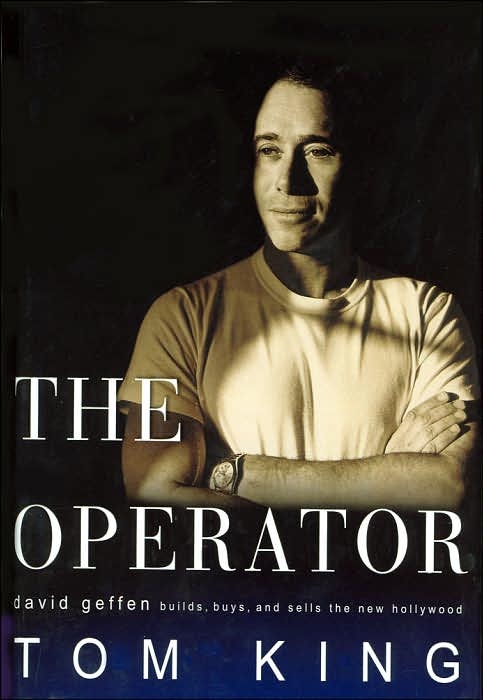
David Geffen buying the L.A. Times would be substantially different than Brian Tierney heading up a consortium to purchase the Inquirer. Tierney's bunch borrowed a lot of money to buy the Inky, and as Dean Singleton has pointed out. it's not much more fun to work for your bankers than for Wall Street. If he wanted to (he wouldn't) Geffen could simply write a check; and no matter how he structured the deal, he wouldn't have the cash flow pressure that operating on borrowed money brings.

I won't presume to know what Jack Welch thinks about when he ponders buying the Boston Globe, except this: he lives in Boston and obviously loves the place. Maybe that adds motivation.

Geffen thinks local ownership of the Times would be good for L.A., too, and I suspect he also figures he already knows a thing or two about building audiences. A writer at LAWeekly last week described what he said Geffen was telling friends:

Now I'm told Geffen is starting to plan what he intends to do to the paper once it's his ... He plans to staff – more like stuff – the paper with name writers and journalism stars. (Of course, he'll raid The New York Times, where Frank Rich and his wife, Alex Witchel, are his good friends and occasional overnight guests. So are Nora Ephron and Nick Pileggi. So are a lot of literati.) He'll demand quality. He'll ratchet up the Web site (even though he hates how prohibitively expensive it is to do that). He'll figure out a way to bring in Latinos as readers ... Geffen hates how boring, badly written, inconsequential and pedestrian the L.A. Times’ editorial and opinion section is. He thinks nobody reads it. He knows nobody talks about it. Most of all, he wants his newspaper to be talked about.

Now, we'd all like a plan that started with hiring more staff. But looking beyond that, think about where this seems to be headed. Brand-name, high-profile buzz. Online extension. Quality. Reaching new demographics.

Not boring.

People at the L.A. Times already know doing those things would help, of course. So do we. But far too often, we let notions about things we "have to do" get in the way of doing things we really believe could move the needle on building audiences and creating communities.

Since you can't just layer on expenses to hire Frank Rich and Nora Ephron, you'd have to stop doing something else. And wouldn't you be better off creating our own stars, anyhow, which might involve little more than giving some of your best people more room to maneuver? Do you have somebody in the paper regularly right now who does this? Show us where to find the best things she's done lately; point us to his column.

Where's the very best stuff at McClatchy? Who has something we just can't live without?
–Howard Weaver

Thursday, November 09, 2006

New touchstones,
enduring mission


We all learned to produce newspapers according to a set of touchstones and metrics that were refined and polished over generations. Success meant a bigger staff, a larger newshole, longer series, more prizes. You staffed and covered everything; running wire on any story within striking range was failure.

Much of that is history.

Some things don’t change. Let’s take it as a given that our mission isn’t different. We’re here to produce the journalism of verification: fair, accurate independent reporting that speaks the truth to power, holds government accountable, gives voice to the voiceless, builds community cohesion. We create and empower citizens. If that’s not our animating purpose, I don’t want to keep doing it.

But standing by ourselves in an empty room telling stories won’t accomplish that.

How do we reorient? What are the new touchstones? Nobody knows for sure yet, of course, but I have some ideas. I wonder if you do, too?

The most important involves turning our yardstick upside down: what matters is not just what we do, but also what people do with it. The educator who argued “I was teaching, but they weren’t learning” had obviously missed the point. So, too, the editor who tries to argue that her decisions were right but the readers didn’t care.

I’d propose this as New Metric Number One: grow audience, in whatever channel and on whatever cycle the audience dictates. Chase them, find them, embrace them, serve them, capture them.

And how about this for Number Two: accept that news is an interactive, collaborative process these days. The audience is your partner in every significant respect, helping shape your decisions and contributing their own voices.

Along the way, we’ll learn the proper weight to attach to other touchstones: engagement; personality; excitement; non-generic ideas and assignments; humor, whimsy, buzz; star quality, brand-name performers; multiple channels and tools.

We will learn how to attach even more value to the tremendous capacities we already have: potent, narrative storytelling; tough-minded independence; levelheaded judgment; non-partisan detachment; fearless, agnostic investigations; deep community roots and understanding.

Any ideas about what else to include in amongst the new touchstones? You could add them as comments here.
–Howard Weaver

Saturday, November 04, 2006

Hyper-local hero

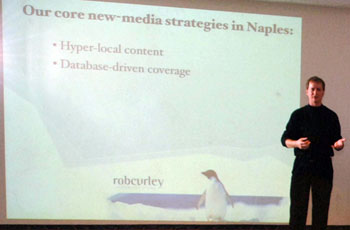
Photo by Bob Christy/Kent State

Rob Curley
has gotten a lot of good press for his success at newspaper websites, but none better than the profile now online at Fast Company. Here's a typical observation:

... then along comes Curley, unburdened by pieties about "how we've always done it." Unlike previous ink-stained generations, he and his mostly young charges practice journalism with software code, video, podcasts, audio, slide shows, blogs--whatever works. Multimedia storytelling comes as naturally to him as satire did to Mencken. Likewise, interactivity: The notion of a newspaper as a conversation rather than a lecture doesn't strike fear in Curley, the way it does some newspaper purists. It's exciting, full of promise.

And although that may seem a little super-heated, there is much to like about the way Curley approaches the business of employing digital tools to extend the work newspapers do. Importantly, one clear focus is on satsfying the information needs of audiences, not just doing what we've always done in different forms. I liked this explanation from Curley:

"Most people still think of a newspaper Web site as a digital version of what went on the press last night, but that's a small part of what we do," Curley says. "I want a site to be so cool and important to people that they talk about it the way you talk about having a great park where you live. It's a local amenity."

–Howard Weaver
So just what is the
Gannett Information Center?


Most of the fanfare yesterday about introduction of the Gannett Information Center centered on the CEO's memo introducing it as "a way to gather and disseminate news and information across all platforms, 24/7. The Information Center will let us gather the very local news and information that customers want, then distribute it when, where and how our customers seek it ... The Information Center, frankly, is the newsroom of the future ... it will be platform agnostic: News and information will be delivered to the right media - be it newspapers, online, mobile, video or ones not yet invented - at the right time. Our customers will decide which they prefer."

Much of that will sound familiar to those of us who gather here to write and talk about what we're doing to accomplish many of those same goals. We don't have a new name or a plan to roll it out in one-size-fits-all across newsrooms, but there's a lot to like about what Gannett is saying.

There's a detailed FAQ posted on Romenesko that you ought to read. The best reporting so far is at Wired News, where they focus on the effort to incorporate distributed reporting ("crowdsourcing" is the term Wired uses) to involve readers in newsgathering efforts.

I have heard Gannett editors express concern in recent months about at least one aspect of the plan. The company says changing the name from newsroom to Information Center recognizes that "[w]hile news remains our preeminent mission, other information – especially local information – is increasingly in demand. Calendars, recommendations, lifestyle topics as well as neighborhood level stories are all new elements..." In early stages of their discussions, at least, there were plans that some editors thought extended the newsroom into areas more akin to advertorial, or outright advertising activity.

Please take time to get up to speed on the Gannett moves, and please share new information about what they're doing and how it's being received in newsrooms. We want to learn all we can – pro and con – to help navigate our own transformations.
–Howard Weaver

Thursday, November 02, 2006

Imagining the future
(and the present)

One of my favorite authors (William Gibson, Neuromancer and Pattern Recognition) had an op-ed piece in the NYT about what we can learn from George Orwell about imagining the future – and describing the present, as well.

I don't know that this bears in any direct way on the subjects we usually address here, but I was intrigued and wanted to share this. Here is the link, and here's a great sample:

It is becoming unprecedentedly difficult for anyone, anyone at all, to keep a secret.

In the age of the leak and the blog, of evidence extraction and link discovery, truths will either out or be outed, later if not sooner. This is something I would bring to the attention of every diplomat, politician and corporate leader: the future, eventually, will find you out. The future, wielding unimaginable tools of transparency, will have its way with you. In the end, you will be seen to have done that which you did.


–Howard Weaver

Tuesday, October 31, 2006

Apologize,
don't ask permission


We talked here not long ago about the death of Tower Records as an object lesson about change and adaptation. It's a powerful example of how to fail by clinging to a misguided notion and refusing to change.

I heard a report on NPR this morning that extends the point even farther.

Mitch Koulouris once worked as a manager for the now-defunct Tower Records retail chain. Five years ago he realized digital music distribution was the wave of the future. Now his company, Digital Music Group, Inc., is buying up old song catalogs and selling them online.


I'll bet that somewhere in your organization there are people who will be the Mitch Koulourises of the newspaper industry. The question we face is whether they'll be doing their pioneering work for us, or as start-ups emerging from our failed enterprises.

We have to provide the space and flexibility and opportunity for people with good ideas to implement them within our companies. Yes, it's hard right now. Publishers and others are often focused on short-term revenues and returns. Capital dollars are scarce.

But competitors (and potential competitors) are plentiful. If somebody at your paper has a good idea for running video obits (welovedthem.com?) you can bet that somebody outside your newspaper does, too. Are we gonna do it, or let them?

Some of this is guerilla warfare. We put the Anchorage Daily News online as a bulletin board system (bbs) called The Front Page in the 1980s – not by asking anybody, but by finding an old Macintosh and teaching ourselves how. I'm sure legal would have complained and IT (if we had any) would have objected.

So what? I'll cover your ass as far as I can, and after that we'll just both get in trouble together.
–Howard Weaver

Tuesday, October 24, 2006

Walking through
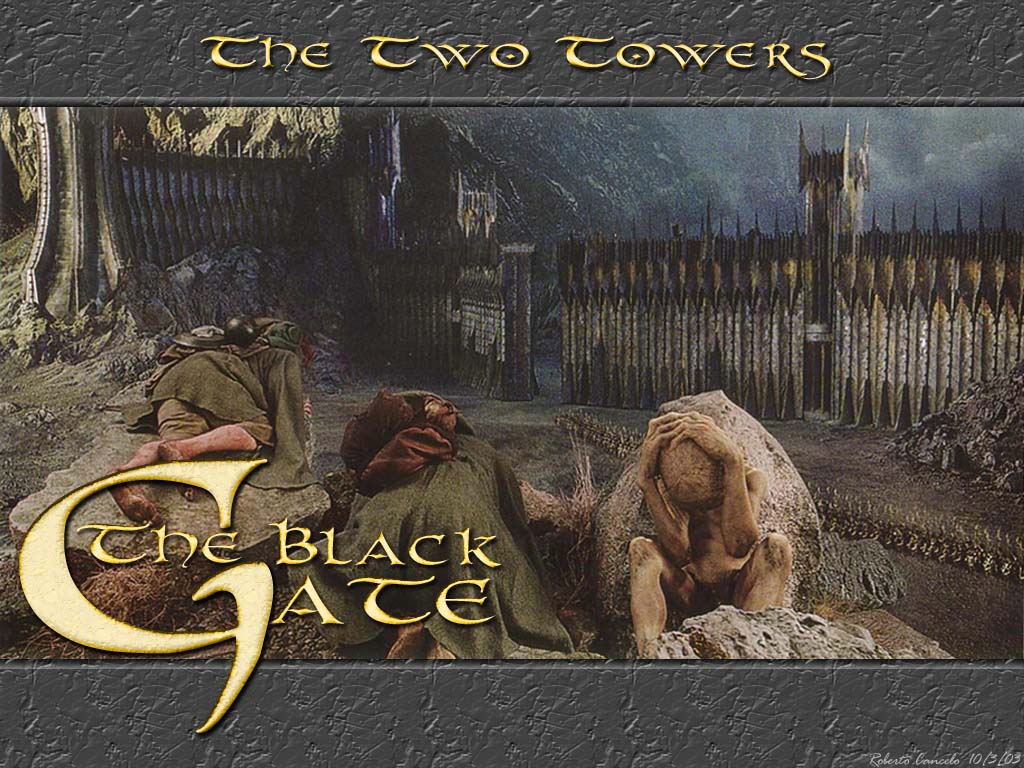
The Black Gate


Talking through our budget battles last week, one of our editors told me, “as Tolkien remarked about hobbits, in our newsroom we do not need hope as long as despair can be postponed.”

We didn’t get a chance to follow-up right away, but the image stuck in my mind, and I searched for the origin. It comes in The Two Towers. At the end of an arduous journey to Mordor, Frodo, Samwise and Gollum watch as the Black Gate closes, and Tolkien tells us,

“After all, [Sam] never had any real hope in the affair from the beginning; but being a cheerful hobbit he had not needed hope, as long as despair could be postponed.”

Importantly, the description “cheerful” here refers not to simple-minded Pollyannism, but to the much more powerful Nordic definition of “cheer” – the outlook that drove Viking warriors on to joyful battle despite (sometimes because of) the odds.

For Christians, hope is grounded in belief that good eventually triumphs; not so for the Scandinavian pagans whose myths Tolkien loved. For them hope is foolish, since evil is expected to triumph in the end. (See The Limitations of Long-Term Hope, by Lorin Rosson III).

Courage combines with cheer as the foundation of the Vikings’ highest virtue: carrying on without guaranteed results simply because the struggle is the right thing to do.

As another aging Boomer was known to say, I believe in hope. But I also admire both courage and cheer, and I know that each approach has its moment.

Our hope for better times rests on the conviction that quality news and information always advantage those who have them – and that if we deliver that when and how audiences want, there will be profits to support us.

There are doubters in our industry and on Wall Street right now. The Present Troubles (higher debt, lower revenues, growing anxieties) compound our budget woes. This is the time for courage – and cheer.

We’re building a bridge from one media world to another. The days of my professional youth, when newspapers dominated InfoWorld and profits could be expected to rise each year, are gone forever. Tomorrow’s pattern is not yet established. The way ahead is opaque at best, daunting at worst. We know it will not all be smooth.

But this is precisely the time to carry on forthrightly because it is the right thing to do. Some of this I can change, and some of it I can’t, but I am entirely in charge of how I respond. I want to be proud of that.
–Howard Weaver

Sunday, October 22, 2006

The poetry of media

I can't improve on the way Raleigh's DME Dan Barkin introduced his musings about how technology has changed and empowered media. Here is a sample of what he said in a longer post at the N&O's editor blog:

I just saw Matt Ehlers in the office. He's been at the fair, writing away on his fair blog. Matt's a reporter in our Features department, and he has a gift for seeing the poetry in life. You can read his blog at http://blogs.newsobserver.com/fair2006/. Here's what he wrote yesterday:

The fair at night is dark and bright, tired carnies and hands held tight.
It's sleeping babies and teenage flirts, country music and airbrushed shirts.
It's glow sticks, magic tricks and candied apples blue.
The fair at night is dark and bright, the fools come out, it's true.


He posted it around 10:44 p.m. Wednesday night. I think if Robert Frost took a run at a State Fair poem, this is how it would come out. Except that Frost didn't post photos and video, which is what Matt is doing as well.

Think about the effort Dan's describing: an energetic, 24/7 kind of assignment aimed at readers' real-world experiences, taking advantage of all the tools in the toolbox. There are video clips, still photos, links -- and the continuing, undiminished power of strong narrative text.

You might also enjoy Dan's reflections on his own journey from manual typewriter to the brave new world. Enjoy.
–Howard Weaver

Friday, October 20, 2006

Talking about real life

In Anchorage, we used to ask ourselves this question: If a Martian was coming to visit and had read a month's worth of the Daily News in advance, what would she expect to find?

Too often, our honest answer was, "a lot of really violent people who love to attend meetings."

We all know our journalism connects better and serves audiences better when it addresses their real lives – not the school board as much as the classroom, less about legislative committee hearings and more about unsafe water that never gets tested.

There's a fabulous example running now at the Charlotte Observer, where staffers are helping people tell stories about teen drinking in the own words. Thoughtfully organized and powerfully presented, these stories address life at the level most of us really live it: worried about our families, puzzled with the trends, confused over "kids these days."

They drink at parties on Friday and Saturday nights -- or on weekdays at home after school. They drink to fit in, belong, impress -- or to feel contented with themselves. Drinking among teenagers is down in the Carolinas from two decades ago, but teens are still abusing alcohol at alarming rates. They're starting at an earlier age and are bingeing more often.

A survey of Charlotte-Mecklenburg high school students this month revealed that 1 in 5 had consumed five drinks in a row in the previous month. One in 4 had climbed into a car with a driver who had been drinking. For most teens who try alcohol, drinking is a rite of passage among peers, a perilous decision with thankfully few consequences. For others, there is a price. Beginning today, we'll bring you their stories. Each is in the person's words, as told to an Observer reporter. Each offers insight into the reach of alcohol -- and its impact on any family.

Included in the series: The messenger. The daughter. The abstainer. The friend. The survivors. The counselor. The voices of teen drinking.

–Howard Weaver

Wednesday, October 18, 2006


Animated opinions

Wow, talk about extending the franchise. Take a look at the way Nick Anderson and the Houston Chronicle are turning traditional editorial cartooning into sophisticated, well-produced animations.

A recent example is available here. And there are archives of other animated work at this link.

The production values here are very high; the animation credits music and graphics assistance at the end. I haven't talked to anybody at the Chronicle about this, but I'd love to know more about how they do it, how much it costs and so on. Anybody have an in there?
–Howard Weaver
Roll your own blogwatch

John Hughes, the Chief Tech Guru (and former letters editor) of the Sacramento Bee opinion pages has developed a marvelous blog aggregation system that pretty much anybody can adapt to their own use. Given these off-the-shelf tools and John's guidelines, you could have a robust site that collects all the most interesting blogs form your area up and online right away. The investment, in time and dollars, is minimal.

There are a number of iterations, but the best intro is found at a site they call ipsoSacto: a taste of our blogosphere. From there, you can link to pages that let you sample a pre-determined listing of Sacramento-area blogs, or tailor a page to your own tastes.

We all need to be in the aggregation game. Simply put, you need to become the central clearinghouse for all the digital, online media in your area -- your own staff, amateurs, competitors. As the established marketplace and name brand, the newspaper site has built-in advantages, but if you don't do it, somebody else will. There's a genuine first-mover advantage here. If you get there first, promote the site online and in paper and offer choices, you should be able to become the dominant source.

That makes using a simple system like John's even more attractive. You don't have to wait for programmers to get around to writing some special software for you, or adapting some complex system you can't manage. This is truly aggregation for the rest of us, and there's little excuse for not trying it now. (You can reach john by clicking on the "Contact" tab at the ipsoSacto site).
–Howard Weaver

Sunday, October 15, 2006

View from the Googleplex

Google's CEO had words of reassurance for "content companies" during this recent interview with the Financial Times, but they were tempered with a warning for the slow and reluctant.

Here's Eric Schmidt sounding like a cooperative and cozy partner:

All of the media companies are dealing with dramatic changes in their business. All of them are looking for a partner. All of them are looking for a way to make money. One of the great news, from our perspective, is people are using this content on the internet. The bad news is it doesn’t make as much money for the businesses. And ultimately the businesses need to make money in order to produce the new content. So what we’re trying to do with all of these partners is to say, ‘if you work with us we can combine our advertising platform and your content with a much larger audience.’ So far people like that message, they are now trying to figure out what to do about it – should they, should they not, under what terms, and those sort of things.


And then here's a taste of the warning he had about the kind of change ahead, and about winners and losers:

You know, every technology dislocation has winners and losers. And the winners are the companies that can adopt these technologies more quickly and the losers are the ones that are stuck, unable to make the transition, unable to take advantage of new technologies. It is clear that the internet and the web and what is generally known as a marketing term of web 2.0 are the defining new technologies. I think that race is underfoot. It’s too early to say who the losers will be. Clearly the winners will include companies like Google and all the other companies that have made their bets on web 2.0.

I think partnerships will be key, and I think we need to get started. Some may turn out to be fundamental building blocks of the 21st century news company. Others will be useful for a while and then fade as conditions change, or as our own capacities grow. Still others will, of course, turn out to be mistakes.

Ready, fire, aim.

We're engaged in that at corporate; I hope many of you are doing the same thing at home.
–Howard Weaver

Saturday, October 14, 2006

Visit scenic atomictown

Chances are that few of you will ever visit Kennewick, Pasco or Richland, the three communities that make up Tri-Cities, WA. But all of you should visit atomictown.com, the entertainment website of the Tri-City Herald.

The entire online operation at the Herald is a continuing workshop in oportunistic innovation. When they get an idea at the Herald, they just do it. The site was a leader in getting high school football video online, runs a killer interactive garage sale workshop, and generally takes full advantage of available, open source tools to make things happen. The small staff there maintains a robust main website, special sites for Kennewick Man and the Hanford nuclear facility, news in Spanish and much more.

My current favorite is atomictown.com, and especially the way staff writer Bethany Lee translates her work into high-quality video. For example, take a look at Bethzilla, Music for Firday the 13th.

How do they do it? Andy Perdue knows: APerdue (at) tri-cityherald.com
–Howard Weaver

Friday, October 13, 2006

Reinvention at the LA Times

You'll no doubt see the NYT story describing how the Los Angeles Times has assigned editors and investigative reporters to examine ways to reinvigorate their work and find new connections with readers. I recommend it.

Among my favorite nuggets:

'We shouldn’t be waiting for corporate headquarters or a think tank or a consultant to come up with ideas to secure our future,' said Marc Duvoisin, an assistant managing editor who will direct the investigation ...

'We realized we had to act fast or we wouldn’t have anything to act for,' said Vernon Loeb, the paper’s California investigations editor, who helped originate the idea.

–Howard Weaver

Monday, October 09, 2006

Young people and news

Here's a short but illuminating report about an Online News Assocation panel of young people talking about how and where they get news. There's nothing new here, but it's crisp and definitive:

If you want to feel old, ask some young people about how they consume news. An ONA Saturday morning panel featured four “digital natives” ranging from 12 to 20 years old who’ve grown up always living in a technological world. Dale Steinke reports below…

Think RSS feeds, off-beat news links shared among friends via IM, social-networking sites, e-mail alerts and short-form stories. No TV in real-time.
It also makes the point that young people don't seem interested in government and political news. Duh. This is the one finding that doesn't scare me; neither was I when I was 12-20 years old ...
–Howard Weaver

Sunday, October 08, 2006


Tower tumbles


When I want to tell people where I live in Sacramento, I use the Tower Theater as a landmark. It’s an old art deco art cinema and restaurant built at the site of the 1940s drugstore that sold 45-rmp records and launched the business that became Tower Records.

Tower was a treasured Sacramento institution, a local business that went global, made money, got cool. As recently as my arrival 11 years ago, its West Sacramento headquarters was an important hub in the worldwide pop music pantheon, a place where aging hippies with pony tails would cut off the neckties of visitors who didn’t know the company dress code.

And now, Tower is no more.

Owners made a lot of excuses for the declining business over the years. My favorite was the contention that there just wasn’t as much good music to sell nowadays. Much of the analysis now talks about how the company was killed by the internet.

But that’s not quite right, of course. What killed Tower was its inability or unwillingness to adapt to the internet.

The Sac Bee has the story here, including this observation:

"If you look at Tower Records over the last 30 years, this is a company that never really changed," said George Whalin, a national retail consultant who grew up near the Tower store on Broadway in Sacramento. "Look at Russ' history -- he's a store guy."
– Howard Weaver
Who do you have to decapitate
to get on Page 1 around here?

Don't miss Michael Kinsley's take on the Tribune Company's situation, op-ed in the Los Angeles Times. Smart ... and fun.
News crush


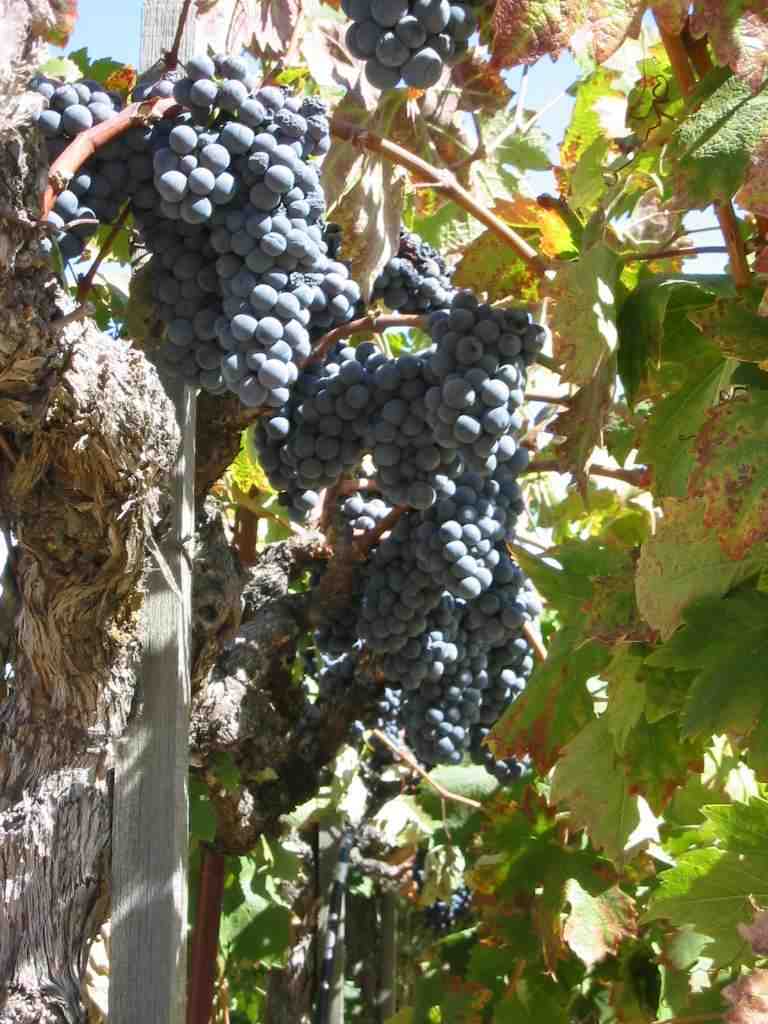
Barb and I have a weekend house nestled amongst vineyards in
California's Shenendoah Valley, about 60 miles east of Sacramento. I no longer drink, but Barb tells me the neighbors make fabulous wine from the Zinfandel and Syrah grapes they grow nearby.

Right now, they're involved in "the crush," a frantic time of year when the grapes have reached optimum ripeness and the vintners are working around the clock to turn them into wine. A year's work and millions of dollars will hang on how the magic of chemistry and taste evolves over the next few weeks.

Our neighbor Elisheva describes the crush simply as "war," and we have all learned not to interfere or expect any significant interaction until it's over. For instance, we really need to have a road committee meeting to get started with some repairs before the rainy season – but there is no point at all in raising those issues now.

What's that have to do with the news business? Well, it seems like an apt analogy for the management challenge you're all facing. Welcome to the news crush; clearly, this is war.

You’re all in the midst of building budgets you know will be hard to live with. You’re dealing with publishers and ad directors focused intently on revenue growth and with circulation departments nervously watching the losses mount. They all want you to satisfy yesterday’s readers in tomorrow’s paper.

And you must, of course, or we won’t make it. But you also have to change how we deal with audiences going forward:

  • Your front page needs to be more compelling, starting tomorrow. You have to encourage new voices, tune the coverage to include new reader preferences, compete more effectively with alternative sources of information and new distractions.
  • You have to move swiftly to fill the new channels we know audiences are moving into: 24/7 updates and alerts; video; cell phones and other mobile platforms.
  • You have to give up the idea that we can serve as ultimate gatekeepers, while not abandoning the sense of standards and professionalism that make us unique and valuable.

Last week an unexpected rain fell on many of the vineyards here. Wet grapes, left unpicked, quickly develop mildew, so other plans went out the window and important tasks were left undone while crews were mobilized to harvest. They might not be able to save all the grapes, so they started with the most valuable. They prioritized quickly and worked furiously.

I watched all this from the sidelines, of course, my only contribution being to stay out of their way.

And our neighbors – smart, politically active people and avid news consumers – are on the sidelines for our fight. We have to figure it out for ourselves.
–Howard Weaver

Tuesday, September 26, 2006

vita.mn therapy

I've flagged the Minneapolis entertainment website vita.mn for you before. As you know, it's now in a soft launch phase, and there are still some features (like good RSS feeds) to attach, but the reviews have already started to come in.

Believe me, you're gonna want this for your own sites. It's worth you while to pay attention now.

Ken Doctor puts it this way in his blog Content Bridges:
Maybe there's just enough time for newspapers to reclaim a fundamental "things-to-do" franchise and grow it in the age of citizen/eater involvement. One bright light that bears attention: the new stealth-mode, very tag-friendly, user-gen-oriented vita.mn product planned by the Star Tribune in Minneapolis.
Here are a few other links worth following:

* gridskipper loves the use of the .mn domain. (It's Mongolia, btw.)

* A robust pro-and-con at mnspeak, where users debate vita.mn's utility.

* Another Minneapolis blog thread, likewise with mixed reviews, is here at Metroblogging Twin Cities.

The idea of content and commentary supplied by users is central to the vita.mn concept, and there haven't been that many users during this soft launch. So it's unspruising that early reviews won't reflect the whole concept.

As more users discover the site and the fabulous tools that let them customize and manipulate it, that will change. You heard it here first.
–Howard Weaver

Sunday, September 24, 2006

More about civil debate

There's a fascinating thread over at The Big Question, where Eric introduced a discussion about how we might avoid the fever swamps of political extremists and engender real, two-way discussion. He concluded:

If there is to be any communication across the divide, people of good faith on both sides have to find each other, find a way to exchange views, try to learn from each other, and use evidence and logic to define their differences down to the philosophical nub.
Chances are this does not lead to a magic moment when all join hands and sing kumbaya. But it does mean we can still converse, still challenge the other side and defend one’s own, still hear the best facts and arguments that are inconvenient to our pre-existing beliefs and, in the best cases, consider whether those facts and arguments require us to rethink what we think we believe.


Amongst the many thoughtful comments from readers, I liked this one:

On a serious note, unfortunately the nutty extremes of each party become the mascot of said party. coulter, michael moore, o’reilly, sheehan. perhaps if the media cease printing the diatribes of these extremists, it would approach normalcy again.
–Howard Weaver

Tuesday, September 19, 2006

A blog explosion

How are your blogs doing? From the sound of this post, it seems like they're doing fine at the Centre Daily Times. You should check out the remarkable activity there, and at powerful, creative blogs being written and hosted throughout the company.

Share links to some of your success stories in the comments below, and we can all have a look.
–Howard Weaver

Sunday, September 17, 2006

Civilizing your blogs

I want to commend to your attention the first two comments appended to the Big Question post below. They are from a civilian reader named Anna, and she offers some thoughtful notions and many useful links to other discussions.

Any of you who are thinking about how to manage the new interactive relationship with readers -- and that should be ALL of you, of course -- will be interested.
–Howard Weaver

Saturday, September 16, 2006

Ask & answer The Big Question

In line with the two posts below about different kinds of campaign coverage, I also should have mentioned Eric Black's pioneering blog/reporting effort at the Star Tribune, called The Big Question.

It's kind of tough to describe (the website's boilerplate is appended below), but it's easy to judge Eric's vigor and to appreciate the robust, mainly civil discussions that it generates. I'd encourage you to have a look, and to share your own ideas and experiences here.

[Remember: anybody can comment here; if you'd like to post -- and please do -- just email Jill Christensen (jchristensen@mcclatchy.com) for an invitation to "join" the blog.]


What is the Big Question?

The Big Question is an experiment by the Star Tribune and StarTribune.com, one based on the belief that our reporting will become stronger and more relevant by inviting you, our readers, to join us in the pursuit.

Whatever the question, our hope is that this blog can serve as a forum for finding and testing facts, with a minimum of rancor or partisanship, in the pursuit of answers, big and small. Despite the often-overheated rhetoric about the mainstream media, it's our belief that those answers will be more convincing and more complete if they are drawn from the insight, expertise and critical assessment of everyone. And that means you.
–Howard Weaver

Thursday, September 14, 2006

Strib readers join the debates

Take a look here for Anders Gyllenhaal's blog post explaining a new feature of election coverage that the Star Tribune calls Debate Tracker:

The idea is that the coverage of every significant debate through Nov. 7th will include a summary and highlights that will be used to build a special page online that tracks the course of debates. This will let readers look at the ebb and flow of debates over time, and also add their thoughts and commentary to the feature.
–Howard Weaver
21st century election coverage ...

I thought you'd be interested in this recent post from Tribal Fires, a blog that exists mainly to bedevil the Anchorage Daily News. Coming from that generally begrudging source, this seems even more impressive.

Slouching towards immediacy

Isn’t it interesting to see ADN transforming itself as this election season wears on? It seems to be changing from a factory that produces a single big slug of news product every morning into something resembling a round-the-clock news operation – like a wire service, or CNN, or an old-time, honey-get-me-rewrite urban tabloid that published several editions a day.

Two cases in point:

1. At 5:35 p.m. Saturday, reporter Kyle Hopkins posted a story on the ADN home page about NEA-Alaska declining to endorse any of the three governor candidates (though it endorsed Knowles only two years ago when he ran for U.S. Senate against Lisa Murkowski). Back in the day, this story would have been all over TV and radio for better than twelve hours before ADN hit our doorsteps in the morning. Now, thanks to the Internet, ADN can be as immediate as the broadcast media.

2. Kyle’s campaign blog. Its biggest effect is to feed the cravings of Billy and other political junkies for a constant flow of info and comment on what the candidates are up to – stuff that, however much we in the blogosphere eat it up, is too insiderish and arcane to make print. But the other effect of the blog is to keep that information coming pretty much in real time, if you allow for the necessity of some time to write and edit. So, not only does the big stuff – like NEA’s non-endorsement – get out immediately. So does the little stuff.

From time to time, media pundits fret about how the dinosaurish old print media can possibly survive in the Internet age. Well, maybe we’re seeing the answer before our very eyes as ADN covers this campaign.

It’s simple (if not always easy) and it’s the same thing newspapers have always done: You go out. You get the story. You write it up. You put it out there. The only thing new is, you don’t wait twelve hours to take that last step.


I know most of you are extending your election (and other) coverage in a variety of ways. Anything special that you'd like to add here?
–Howard Weaver

Monday, September 04, 2006


Lessons from ‘Modern Times’

I’ve been listening all weekend to Bob Dylan’s new release, “Modern Times.”

What a remarkable thing this is: in the 45th year of a storied recording career, here’s a singer and songwriter opening new doors, building confidently on a canon that has long since passed from legendary to unparalleled, touring more than 100 days a year to hone a sound and style that is fundamentally, undeniably his, but keeps evolving and changing along with the artist and his times.

His last great album, “Love & Theft” (2001) was a candid conversation about age and limits and regrets; this one is none of that. It’s deeply informed by a lifetime of experience – songs only a mature master could have produced – but manages nonetheless to be fresh and contemporary.

So what’s that got to do with a newspaper blog? Well, nothing of course.

And everything.

You see, this is about constant reinvention. Dylan was fantastic in 1966 at the Albert Hall, but that performance wouldn’t be Dylan today, or resonate with listeners today the way it did then. Lots of the other musicians who captured our attention in 1966 kept playing and singing the same way, and today they’re playing pathetic gigs at Holiday Inns in Billings and Greensboro …

You want to avoid the Holiday Inn? You have to keep your news report fresh, tuned, contemporary. You have to realize that people are watching TV on mobile phones, posting their own restaurant reviews, reading little snips of five different newspapers on RSS feeds several times a day.

Those bands replaying their 1966 performances are dead. Bob Dylan lives on.

In fact, wasn’t it Dylan who said, “He not busy being born is busy dying.”?

Saturday, September 02, 2006

Song

A rowan, like a lipsticked girl.
Between the by-road and the main road
Alder trees at a wet and dripping distance
Stand off among the rushes.
There are the mud-flowers of dialect
And the immortelles of perfect pitch
And that moment when the bird sings very close
To the music of what happens.

–Seamus Heaney

Friday, September 01, 2006


Asking about news

It sounds a bit simpleminded, I know, but lately I have taken to asking people – friends, barristas in coffee houses, guys smoking outside a restaurant – where they get their news, and why. I'm more forward then I used to be when I see Google News of their computer screen or see them reading the alternative paper, or hear them mentioning some blog they saw.

Do any of you do this? What are people telling you?
–Howard Weaver

A killer's confession

News & Observer editors faced an extraordinary decision Thursday night: What to do with a teenaged killer's videotaped confession and monolog that had been delivered exclusively to them?

There's no way words alone can describe the impact of the four video segments they finally decided to post online. You can can read the story and find a link to the clips here.

Melanie's thoughtful blog post about their decision-making is well worth your attention; you can find it here. For one thing, as Mel points out, while this was the first time they had to make decisions about how to handle incendiary video, it surely won't be the last. Your time is probably coming, too.

Wednesday, August 30, 2006


Hot fuel, hot story

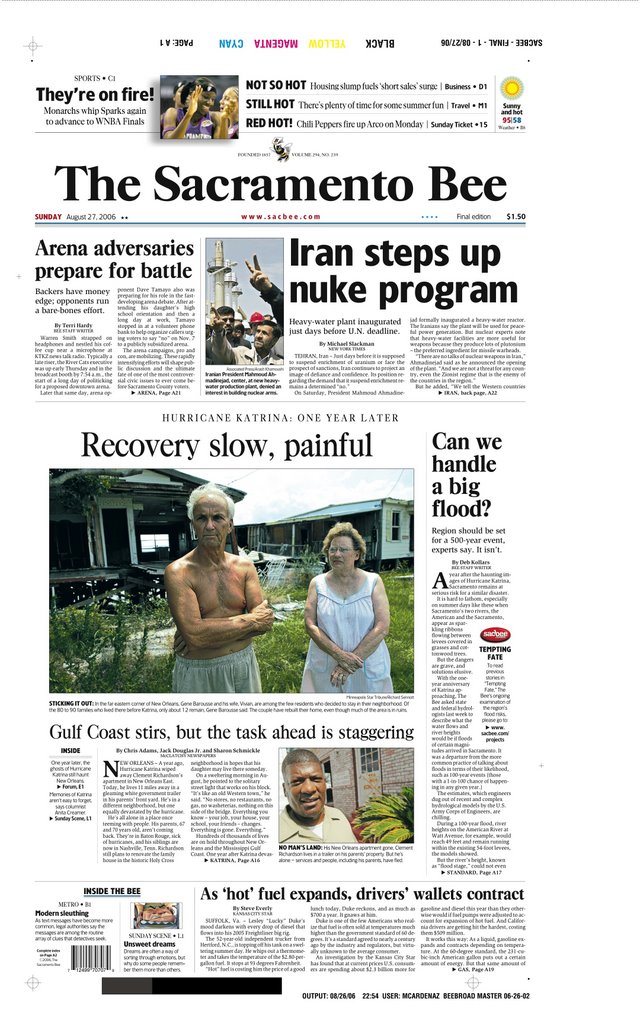
Kansas City's powerful "Hot Fuel" stories appeared around the country recently, provoking a storm of reaction. Among other readers was California's AG Bill Lockyear who (presumably) saw the A-1 story in The Sacramento Bee (pictured here) and ordered an investigation here in the nation's gasoline-thirstiest state.

I thought you'd be proud (as I was) to see this reaction, representative of what we're hearing from around the country. This testimonial is from Mark Lauffer, wire desk supervisor at the Arizona Republic:

I am in charge of wires for The Arizona Republic in Phoenix. I was blown away by your hot fuel series. When I pitched it to our editors last week, they were blown away, too. We ran it on Monday and Tuesday Aug. 28-29 on the front page. On Monday it was the lead story / centerpiece, above the fold. We a photo and graphic on the cover and another graphic inside. On Tuesday, we did an Arizona reaction piece to go with your story and we used another photo and graphic. By the way, the graphics showing how hot fuel works and how the pumps would work were outstanding.

I see on the wires that hot fuel already is becoming a campaign issue in Missouri. You and your staff may end up affecting millions of Americans.

What better journalism is there? When I pitched the story, I said it could be the best piece of consumer reporting I had ever seen.

–Howard Weaver

Thursday, August 24, 2006


Should we broadcast news on the web?

I met last week with the founder of an internet-based audio news service called the Quality News Network. This embryonic outfit consists of about a half-dozen journalists in Monterey, CA who write and present an hourly news report intended to serve as a more substantive alternative to network radio. They also do interview programs, candidate interviews and the like.

They want some kind of relationship with us. At the simplest level, we might link to (or otherwise implement) their newscasts from our websites, adding an audio component and, presumably, some advertising opportunities.

If you get a chance, go to Quality News Network and listen to a little of their work. Let me know if you think it's the kind of thing that would enhance your website.
–Howard Weaver

Sunday, August 20, 2006

Linking Raleigh and Charlotte

Ted Vaden, the News & Observer's excellent public editor, has a piece today that describes increasing cooperation between the N&O and their new cousins in Charlotte. He also asks whether this will be good for readers and decides that it probably will be, in the main.

We'll be talking a lot about sharing and cooperation in Ft Worth Tuesday. You might want to look at the Vaden column here.
–Howard Weaver

Saturday, August 19, 2006


Pew survey on the press

This detailed Pew study on how people get news and what they think about it was released July 30, but I just came across it. On first blush it seems to like their analysis is fairly predictable and occasionally superficial.

The lead breathlessly reports that 10 years ago only one in 50 Americans read news on the internet. Hell, 10 years ago even people that knew about the internet were lsitening to AOL busy signals on 1200-baud dial-up. I also don't find it illuminating to know that in 1965, 71 percent of news consumers read the paper; what else were we going to do?

But there's clearly a wealth of detail in the subsequent section about attitudes, media credibility (WSJ was most credible newspaper) and the like. I'd love to hear what you found most interesting.
–Howard Weaver
NABJ recruiting report

I joked with some of you that for some reason, I had never been as popular at ASNE as I was at this year’s convention.

Judging from our reception at NABJ in Indianapolis this week, the same is true for our whole company. Although attendance at the convention and recruiting fair were down and the total number of interviews reduced, I had more inquiries from experienced, talented journalists than ever before.

There were Blackberry-based scanners that let us record barcodes from name badges of applicants, so we should have a fairly comprehensive database of names from our walk-up traffic. Many candidates were interviewed by only one or two of us, of course, so it may be a little harder to get details on everybody, but we’ll work to gather that info, as well.

We had a couple of corporate folks and recruiters from Miami, Ft Worth, Kansas City, Raleigh, Columbus, Tacoma, Myrtle Beach, Belleville, Charlotte, Wichita and probably somebody I forgot (sorry). All did yeoman duty on the floor and in the hallways. How they did at the parties remains unreported.

This was my first experience working with Knight Ridder’s super-rep Reggie Stuart, who worked hard and well on our behalf. He’s a legend in recruiting circles, for good reason, and it was a pleasure to have his assistance.

We’ll talk some in Ft Worth Tuesday about opportunities. We need to be sure we capitalize on them all.
–Howard Weaver

Wednesday, August 16, 2006

Shashank Bengali,
interviewing in Ethipoia


Meet your correspondent

There's a nice interview online at the South Asia Journalists Association with McClatchy Africa correpsondent Shashank Bengali, who has lately been one of our team covering war in the Middle East.

I haven't met Shashank yet, and found the story illuminating. I think you'll find some insight here into the dedication our folks are bring to their work overseas. You can read the whole piece here.

Tuesday, August 15, 2006

Football, anybody?

I happen to know that at the News & Observer it's called High School Huddle. What's special about local football coverage at your paper? (Are you listening, Ft. Worth?)
–Howard Weaver
Be the clearninghouse

This post was adapted from a comment I shared on the new editorial page editors listserve:

Like many of you, I started a local community columnist rotation while I was EPE in Anchorage. (We called it "Compass: points of view from our community." Clever, huh?) It's still running and while I assume it is still as big a pain as it was back then, to my occasional eye it still looks like a valuable addition.

One huge difference between now and the Olden Days when I was editing: blogs.

There is a lot of spirited, robust local opinion being written in your communities, whether you know it or not. Much of it would not meet your standards for publication, but even in its more extreme iterations, it's indicative of local passion and engagement you need to be aware of. If you're not plugged into the local blogosphere, somebody on your staff damned sure better be.

I have seen some prototypes of a very promising effort at Sac Bee to make the opinion page's web presence a clearinghouse for local opinion blogs. As the leading media company in your community, you need to be the one-stop shop people turn to for pointers to such items. With few exceptions, it will be to our advantage to be the place where people come to explore local commentary ... even when the commentary itself sometimes comes in packages we wouldn't otherwise endorse.

When David feels ready, I hope he'll open that experiment up for you all to see.

Yes, this will be tricky. But I think it's essential. If you don't fill this need, somebody else will, and your own voice will be increasingly marginalized.
– Howard Weaver
The art of talk

I have long thought there was much for us to learn from ESPN.

The network doesn't do everything well; despite some exceptions, it isn't much for investigative journalism, for example. It seems tone deaf on occasion, as when it allowed Barry Bonds unfettered air for his point of view while controversy swirled around him everywhere else.

But as a demonstration of enthusiasm and focused energy, it has no peer. There's a palpable sense of fun in every Sports Center broadcast, of staffer's expertise and deep knowledge, of precision calibration of what the audience wants.

I wish our sports sections had half the energy and excitement.

Now there's an intriguing story from NPR about another enviable aspect of ESPN: the training course it mandates to teach staffers how to interview.

Nut graph:

Now, every single editorial employee at ESPN is expected to attend a three-day seminar, where they encounter a lanky, slightly awkward 58-year-old man with little flash. In his efforts to illustrate what he considers the "seven deadly sins of interviewing," John Sawatsky methodically eviscerates the nation's most prominent television journalists.

"I want to change the culture of the journalistic interview," Sawatsky says. "We interview no better now than we did 30 years ago. In some ways, we interview worse."

You can read a transcript of the David Folkenflik story (and listen to some audio about interviewing technique) at this link.
–Howard Weaver

Monday, August 14, 2006

Assault on the press

We've talked some here about the corrosive effect created by constant attacks on press. The noise machine powered by ideological bloggers, hysterical talk show hosts and partisan news organizations trumpets our failings (real and imagined) 24/7.

But the bigger threat by far comes from a much more potent source: the government of the United States. New Yorker editor David Remnick does a fine job of detailing that in a brief Talk Of The Town piece you can find here.

Here's a frightening sample:

In the past six years, the Administration and its surrogates have issued a stream of disinformation about intelligence an Iraq; paid friendly “columnists” like Armstrong Williams and Maggie Gallagher tens of thousands of dollars to parrot the White House line; accredited to the White House press corps a phony journalist and ex-prostitute (Jeff “Bulldog” Gannon, a.k.a. James Dal Guckert) as a reliable pitcher of softball questions; tightened Freedom of Information Act restrictions; and pioneered a genre of fake news via packaged video “reports.” The President has held fewer solo news conference than any of his modern predecessors The Vice-President kept the Times reporter off his plane because he didn’t like the paper’s coverage...

I was raised in the "never let 'em see you sweat" era of newspapers. "We stand by our story," you said in public. On a panel discussion you might venture as far as, "The journalism speaks for itself."

That's not cutting it any more. It's past time to fight back.
–Howard Weaver

Sunday, August 06, 2006

About trust and transparency

Here's a link to a story from AP about the survey that found half the adults in America believing that there were WMDs in Iraq just before our invasion.

My own view is reflected in this quote:
"I'm flabbergasted," said Michael Massing, a media critic whose writings dissected the largely unquestioning U.S. news reporting on the Bush administration's shaky WMD claims in 2002-03.

"This finding just has to cause despair among those of us who hope for an informed public able to draw reasonable conclusions based on evidence," Massing said.

So, what are we going to do about this?

We talked about transparency and wasy to "build and maintain reader trust" at a McClatchy meeting about a year ago. I made some notes about ideas that surfaced, including these:

• Greater transparency however possible
o Invite readers to a-1 budget meetings
o Pubish statement of purpose regularly
• On front page?
o Ask readers to hold us accountable
o Public editors
o Accuracy questionnaires
• Use web as authentication (eg publish transcripts, back-up documentation for controversial stories)
• Find ways to talk with readers when there’s no current crisis or problem
• Webcast endorsement interviews at editorial board?
• Tell readers about news staff credentials (house ads? Bio blurbs?)
• Use the “how we got this story” form to explain our process more often
Are you doing or thinking about other things that could help?

–Howard Weaver
 
/*